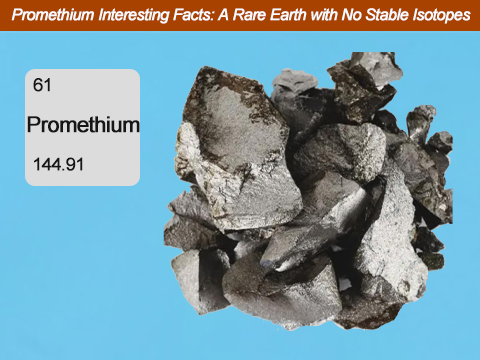
Promethium (symbol Pm, atomic number 61) is one of the most unusual elements in the periodic table. It is a rare earth metal that has no stable isotopes, meaning every form of promethium is radioactive. Even more surprising, scientists estimate that at any given moment, only about 500–600 grams of promethium exist naturally in Earth's crust. That is less than the weight of a typical laptop.
Because of this extreme rarity and its radioactive nature, promethium is not used in everyday products. Instead, it appears in highly specialized technologies where long-term reliability, compact energy, or precise measurement matters more than cost or volume. These promethium interesting facts explain why element 61 continues to fascinate scientists, engineers, and advanced materials buyers.
Below is a quick overview before we explore the details.
Promethium at a glance
| Atomic number | 61 |
| Element group | Lanthanide (rare earth element) |
| Stable isotopes | None |
| Most important isotope | Pm-147 (half-life 2.62 years) |
| Natural abundance | ~500–600 g globally at any time |
| Key uses of promethium | Nuclear batteries, luminous devices, thickness gauges, industrial sensors |
Promethium is a silvery metallic rare earth element with the chemical symbol Pm and atomic number 61. It belongs to the lanthanide series and is unique because it has no stable isotopes. This makes it naturally radioactive in all forms. In chemistry, promethium almost always exists in a +3 oxidation state. This is similar to most other lanthanides.
One of the most interesting promethium facts is that it sits between neodymium (Nd) and samarium (Sm) on the periodic table. Both of them have stable isotopes and are widely used in industry. Promethium breaks this pattern completely. Despite being surrounded by useful and relatively common rare earths, promethium itself is extremely scarce and unstable.
In nature, promethium forms only as a short-lived byproduct of uranium fission and radioactive decay. Any naturally occurring promethium quickly decays into other elements. As a result, almost all promethium used today is produced artificially in nuclear reactors. This is done by separating it from spent nuclear fuel. The isotope Pm-147 is the most commercially relevant. This is due to its suitable half-life and radiation characteristics.
Engineers and researchers need to know what promethium is. This helps them understand why it has so many specialized applications. Promethium is not a general-purpose rare earth metal. Instead, it is a niche material chosen only when its radioactive properties provide a clear technical advantage.
Promethium is often described as the rarest rare earth element, and the numbers behind that claim are striking. Scientists estimate that at any moment, only about 500 to 600 grams of promethium exist naturally in the entire Earth's crust. This is because promethium has no stable isotopes and is constantly decaying as fast as it is created.
Other rare earth elements are mined from ores. However, promethium cannot be economically extracted from natural deposits. Any promethium formed during geological processes disappears over time due to radioactive decay. This makes promethium fundamentally different from elements like neodymium, gadolinium, or ytterbium. Those elements can accumulate in usable quantities.
The most studied isotopes of promethium are Pm-147 and Pm-145. Pm-147 has a half-life of about 2.62 years, while Pm-145 lasts longer, with a half-life of around 17.7 years. Even these longer-lived isotopes are short-lived by industrial standards, which further limits availability.
Promethium isotope overview
| Isotope | Half-life (years) | Radiation type | Typical use |
| Pm-147 | 2.62 | Beta | Nuclear batteries, gauges, sensors |
| Pm-145 | 17.7 | Beta, gamma | Research, specialized sources |
In the United States, Oak Ridge National Laboratory has historically been the only domestic producer of Pm-147. This fact highlights how restricted the supply chain is. These promethium facts are interesting for buyers and engineers. They show why projects involving promethium require careful planning, strict documentation, and experienced partners familiar with regulated materials.
One of the most fascinating promethium interesting facts is that it can glow in the dark. This glow does not come from the metal itself shining like a light bulb. Instead, it happens when promethium's radioactive decay excites nearby phosphor materials. This causes them to emit visible light, often with a soft violet or bluish tone.
Historically, promethium compounds were used in luminous paints for instrument panels, gauges, and safety markings. Unlike traditional phosphorescent materials that need to be "charged" by light, promethium-based luminous systems generate light continuously. The energy comes directly from radioactive decay, not from stored light energy.
This property made promethium attractive for environments where reliability mattered more than brightness. For example, aircraft instruments, military equipment, and scientific devices needed markings that stayed visible for years without maintenance or external power.
Comparison of luminous technologies
| Technology | Brightness stability | Typical lifetime | Maintenance needs |
| Promethium-based | Very stable | Several years | None |
| Tritium-based | Stable | 10–20 years | Minimal |
| Conventional phosphors | Low | Short | Frequent recharging |
Many of these uses have declined due to regulatory concerns and the availability of safer alternatives. However, the underlying principle still influences modern materials design. Engineers continue to study how controlled radiation can deliver long-term, maintenance-free performance. This is one reason the uses of promethium remain relevant in discussions about extreme-environment technologies.
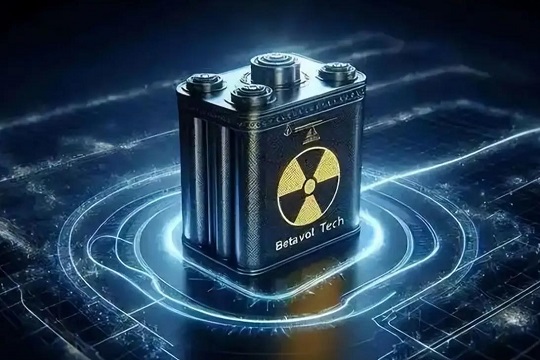
Among the most important uses of promethium is its role in nuclear batteries, also known as betavoltaic batteries. These devices convert beta radiation into electricity. This method produces small but steady amounts of power over long periods. Pm-147 is especially suitable because it emits low-energy beta particles that are easier to shield and manage safely.
Promethium-powered nuclear batteries do not provide high power output. Instead, they excel in applications where replacing a battery is difficult or impossible. Examples include satellites, remote sensors, space probes, and historically, early medical implants such as pacemakers.
A key advantage of promethium-based nuclear batteries is reliability. Unlike chemical batteries, they do not degrade quickly due to temperature changes, pressure, or long storage times. As long as the isotope continues to decay, it produces usable energy.
Typical promethium nuclear battery applications
| Application | Power level | Service life | Maintenance |
| Satellite sensors | Very low (mW range) | Several years | None |
| Remote monitoring devices | Low | Multi-year | None |
| Early medical implants | Very low | Long-term | None |
Although newer technologies and other isotopes are now more common, promethium played a critical role in proving that compact nuclear power sources were practical. These promethium interesting facts show why the element still appears in research related to long-life energy systems and extreme-environment electronics.

Beyond power generation, promethium has played an important role in industrial measurement and control. One of the most well-known uses of promethium is in radiometric thickness gauges. These devices measure the thickness or density of materials such as metal sheets, paper, or plastic. The measurement could be done without making physical contact.
In a typical setup, a promethium beta source emits radiation toward a detector. As material passes between them, changes in radiation intensity reveal thickness variations in real time. This allows manufacturers to monitor quality continuously without stopping production lines.
Promethium has also been used in compact X-ray sources and certain non-destructive testing (NDT) tools. These systems benefit from promethium's steady radiation output and relatively compact size. This makes them suitable for portable or fixed industrial equipment.
Key industrial uses of promethium include:
For manufacturers, these uses of promethium reduce downtime, improve measurement accuracy, and support automation. Even though many modern systems now use alternative isotopes, promethium's role helped establish radiometric measurement as a standard industrial technique.

Aerospace and defense applications highlight why promethium is considered a high-value, niche material. In space exploration, solar power is not always practical, especially for deep-space missions or shadowed environments. Nuclear batteries using isotopes like Pm-147 provided early solutions to this challenge.
Promethium-based power sources have been used to power instruments on satellites and space probes. This ensures that these instruments can operate continuously even when they are far from Earth. The low maintenance requirement is especially important in space, where repairs are impossible.
In defense and aerospace systems, promethium has supported remote sensors and monitoring devices that must function reliably for years. These systems often operate in harsh environments, including extreme temperatures, radiation exposure, and mechanical stress.
Examples of aerospace-related uses of promethium include:
Although promethium is not widely used today compared to other rare earths, its history in aerospace shows how specialized materials can solve problems that conventional technologies cannot. These promethium interesting facts help explain why engineers still study it when designing next-generation systems.
All promethium isotopes are radioactive, which makes safety and regulation a central concern. Handling promethium requires strict controls, including shielding, licensing, transport documentation, and proper disposal. Because of these challenges, promethium is generally limited to licensed industrial, medical, and research environments.
Regulatory bodies closely monitor the use of promethium. The purpose is to minimize radiation exposure to workers and the public. Even though Pm-147 emits relatively low-energy beta radiation, improper handling can still pose health risks.
For engineers and sourcing teams, this regulatory complexity often outweighs the technical benefits. In many cases, non-radioactive rare earth elements can achieve similar performance without the added compliance burden.
This is why many modern designs favor stable rare earths such as gadolinium, cerium, or ytterbium. These materials offer strong magnetic, optical, or catalytic properties while remaining easier to handle and ship. Knowing these promethium interesting facts helps buyers decide when it's really necessary to use radioactive materials.
Promethium stands apart from other rare earth elements because of its radioactivity. While this makes it valuable in certain applications, it also limits its use. Comparing promethium to more common rare earths helps clarify when it is the right choice.
Comparison of promethium and other rare earths
| Element | Radioactive? | Key strength | Typical applications | Regulatory complexity |
| Promethium | Yes | Long-life radiation source | Nuclear batteries, gauges | High |
| Gadolinium | No | Strong neutron absorption | Medical imaging, reactors | Low |
| Ytterbium | No | Optical and laser properties | Lasers, fiber optics | Low |
| Lutetium | No | High density, stability | Detectors, catalysts | Medium |
Promethium is best used when a built-in radiation source is essential, such as in nuclear batteries or radiometric instruments. For most aerospace, electronics, and medical devices, stable rare earths provide better performance-to-risk ratios. This comparison reinforces that the uses of promethium are highly specialized rather than general-purpose.
Promethium has a unique place in scientific history. It was predicted to exist in the early 1900s but was not successfully isolated until 1945 at Oak Ridge National Laboratory. This made it one of the last lanthanides to be fully characterized.
For decades, promethium remained a "missing piece" in lanthanide chemistry. Many fundamental properties, such as precise bond lengths, were unknown because researchers could not obtain sufficient quantities safely. Only recently have scientists filled these gaps using advanced techniques.
One notable discovery confirmed that lanthanide contraction, a trend where atomic sizes shrink across the series, accelerates up to promethium and then slows. This finding helped validate long-standing theoretical models and improved understanding of rare earth behavior.
These promethium interesting facts highlight how even obscure elements can influence broader scientific knowledge. For materials engineers, this research matters because it improves predictions about alloy behavior, bonding, and performance in advanced applications.
Promethium is not a material most engineers will ever specify, but understanding it still provides value. It represents an extreme case where rarity, radioactivity, and performance intersect. Knowing when promethium is useful helps clarify when other rare earth elements are better choices.
Promethium makes sense in situations that require:
In contrast, many modern systems benefit more from stable rare earths that deliver high performance without regulatory challenges. For aerospace, medical, electronics, and energy applications, careful material selection is critical for cost, safety, and reliability.
By understanding these promethium interesting facts and the real-world uses of promethium, engineers and buyers can make smarter decisions. In many cases, it's better to consult rare earth specialists early in the design process. This can help you decide whether to use promethium or choose a more practical alternative.
Promethium is a powerful reminder that not all rare earth elements are meant for mass use. As these promethium interesting facts show, element 61 is extraordinarily rare, inherently radioactive. It's suited only to a small set of highly specialized applications such as nuclear batteries, radiometric gauges, and long-life sensors in extreme environments. Its lack of stable isotopes, strict regulatory requirements, and limited supply mean that promethium is chosen only when no other material can meet the technical need.
For most real-world engineering, manufacturing, and research projects, stable rare earth metals and compounds offer a far more practical balance of performance, safety, cost, and availability. Elements like scandium, gadolinium, ytterbium, cerium, and other lanthanides are important in aerospace structures, medical devices, electronics, energy systems, sensors, magnets, and advanced manufacturing. They do this without the added complexity that radioactive materials introduce.
At AEM REE, while we do not supply promethium, we specialize in high-purity rare earth metals, oxides, alloys that support demanding, high-spec applications worldwide. Our team works closely with engineers, researchers, and sourcing professionals to help you select the most suitable rare earth material for your performance goals, regulatory environment, and long-term supply needs.
If you are exploring advanced materials for aerospace, electronics, energy, medical, or industrial systems—and are evaluating alternatives to radioactive elements—we invite you to contact AEM REE and discuss your requirements with our rare earth experts. A short conversation early in your project can help you avoid unnecessary complexity and identify a safer, more efficient rare earth solution tailored to your application.
 +86-731-89578196