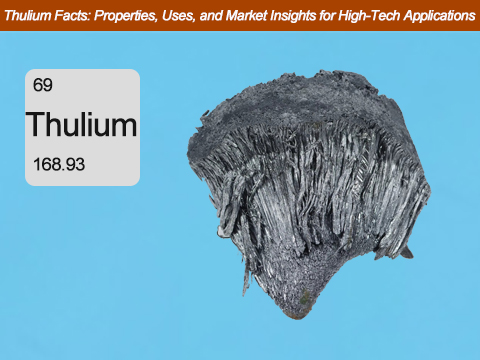
Before diving into details, these thulium facts summarize why this rare earth element matters to engineers, OEM buyers, and researchers:
| Item |
Key Fact
|
| Element name | Thulium |
|
Symbol
|
Tm
|
|
Atomic number
|
69
|
|
Series
|
Lanthanide (heavy rare earth element)
|
|
Crustal abundance
|
~0.5 ppm (one of the rarest REEs)
|
|
Typical forms
|
Metal, oxide, salts, doped materials
|
|
Key uses
|
Medical lasers, portable X-ray sources, IR lasers, displays
|
|
Supply characteristic
|
By-product, limited volume, supply concentrated
|
|
Buyer takeaway
|
Strategic sourcing is critical
|
These thulium facts show that thulium is not a bulk industrial metal. Instead, it is a rare earth element that is used in places where precision, stability and performance are more important than how much is used. This makes it especially useful for advanced manufacturing, medical devices, electronics, and research-driven industries.
Thulium is one of the least abundant naturally occurring rare earth elements. This scarcity shapes almost every aspect of its use. From a chemical standpoint, thulium is a silvery-gray metal that belongs to the lanthanide series. Its chemical symbol is Tm, and it has an atomic number of 69, placing it among the so-called heavy rare earth elements. Geological data shows that thulium is about 0.5 parts per million in the Earth's crust, which is rarer than many other lanthanides.
One of the most important thulium facts for buyers is that thulium is rarely mined on its own. Instead, it is recovered as a by-product during the processing of minerals such as monazite, bastnäsite, and xenotime. These ores are primarily mined for more abundant rare earths like cerium, lanthanum, or yttrium. As a result, thulium supply depends heavily on demand for other elements, not on thulium demand alone.
Why does this matter? Because thulium is mainly used in high-value niche applications, not in mass markets. Engineers rely on thulium for compact medical lasers, precise optical components, portable X-ray sources, and advanced sensing systems. In many of these applications, even small changes in purity or consistency can affect performance. This makes thulium a great choice for professionals who design, build or integrate advanced equipment and need materials they can trust.
Anyone designing components or systems that depend on rare earth materials must understand the physical and chemical properties of thulium. Many thulium facts that matter most to engineers relate directly to how well it works under heat, in optical systems, or in controlled magnetic environments.
The table below compares thulium with two neighboring rare earth elements that are often used in similar ways: erbium and ytterbium.
|
Property
|
Thulium (Tm)
|
Erbium (Er)
|
Ytterbium (Yb)
|
|
Atomic number
|
69
|
68 | 70 |
|
Atomic weight
|
~168.93
|
~167.26
|
~173.05
|
|
Melting point (°C)
|
~1545
|
~1529
|
~824
|
|
Boiling point (°C)
|
~1950
|
~2868
|
~1196
|
|
Density (g/cm³)
|
~9.32
|
~9.07
|
~6.97
|
|
Typical commercial purity
|
99.5–99.99%
|
99.5–99.99%
|
99.5–99.99%
|
From an engineering perspective, these numbers tell an important story. Due to its high melting point, thulium is suitable for use in high-temperature or high-energy environments. For example, it could be used in laser systems and specialized optical components. Its density is higher than many other lanthanides. This can influence component weight and thermal behavior in compact systems.
Another key set of thulium facts relates to stability and optical performance. Thulium is reasonably stable in air compared with more reactive lanthanides. It can form a thin oxide layer that protects the bulk metal. This makes handling and storage somewhat easier than for extremely reactive rare earth metals.
Thulium also exhibits useful magnetic and optical transitions, particularly in the infrared region. These transitions are what make thulium valuable in laser and sensing applications. Engineers pay attention to this point because predictable optical properties directly affect system reliability. In other words, thulium combines thermal stability, easily controllable reactivity, and unique optical properties that are difficult to match with other elements.
Thulium (Tm) is a rare metallic element, relatively scarce in nature, and belongs to the rare earth elements. Thulium has a relatively low concentration in the Earth's crust, accounting for a very small fraction of its weight, approximately 0.0015%. This makes thulium relatively rare in nature.
Thulium primarily exists in nature in the form of compounds, rather than as a pure metal. Common thulium minerals include chalcopyrite (CuGaS2). But this mineral is relatively rare and not economically significant. Additionally, thulium may be present as a byproduct in the industrial processing of some ores, such as sphalerite, pyrite, bauxite, and germanite.
Currently, over 90% of the world's primary thulium is extracted during the production of alumina. This is a method of comprehensively utilizing mineral resources. Extracting thulium from the alumina production process increases the added value of mineral resources. It also improves the quality of alumina and reduces environmental pollution from the waste product "red mud."
|
Factor
|
Impact on Buyers
|
|
Low crustal abundance
|
Limited natural availability
|
|
By-product production
|
Supply depends on other REEs
|
|
Complex separation
|
Higher processing cost
|
|
Concentrated supply
|
Geopolitical and logistics risk
|
These thulium facts explain why prices can be relatively high and why lead times may be longer compared with more common rare earth elements. For buyers, this means thulium sourcing should be treated as a strategic decision. Working with a specialized rare earth supplier can help mitigate risks related to availability, quality, and long-term planning.

One of the most visible and fast-growing areas of thulium facts is its use in medical lasers and imaging equipment. Thulium-doped lasers, including both fiber and solid-state designs, typically operate around a wavelength of 2 micrometers. This wavelength is especially good for medical procedures because it allows precise cutting with limited penetration depth.
In practical terms, this means surgeons can remove or modify tissue with a high level of control while minimizing damage to surrounding areas. Thulium lasers also offer strong hemostasis, which helps reduce bleeding during procedures. These advantages make thulium lasers particularly attractive for minimally invasive surgery.
Market data reflects this growing importance. The global market for thulium medical lasers is valued at roughly 89 million USD in 2025. It's projected to grow at a compound annual growth rate of about 6.1% through 2033. Around 40% of current uses are urology applications. There is also increasing use in dermatology and ophthalmology as laser technology improves.
|
Application
|
Approximate Trend
|
Key Benefits
|
|
Urology
|
~40% of use
|
Precision, reduced bleeding
|
|
Dermatology
|
Growing
|
Controlled ablation
|
|
Ophthalmology
|
Growing
|
Minimal collateral damage
|
|
Other surgery
|
Emerging
|
Faster recovery
|
From an engineering and procurement standpoint, these thulium facts highlight a critical pain point: laser performance depends heavily on the consistency and purity of rare earth inputs. OEMs designing medical devices must rely on stable, specification-tight thulium materials to meet both performance expectations and regulatory requirements.
Another important category of thulium facts involves thulium-170. It's a radioactive isotope used in specialized imaging and inspection systems. Thulium-170 emits gamma radiation that can be harnessed to produce X-rays. This makes it useful as a compact radiation source.
One key advantage of thulium-170 is its ability to support small, portable systems. Traditional X-ray tubes can be bulky and power-intensive. This limits their use in field applications. In contrast, thulium-170 enables mobile medical imaging units and certain non-destructive testing systems used in industrial or security settings.
|
Parameter
|
Typical Value
|
|
Isotope
|
Thulium-170
|
|
Half-life
|
~128 days
|
|
Common uses
|
Portable X-ray, NDT, inspection
|
It is important to note that handling thulium-170 requires strict regulatory compliance, shielding, and safety protocols. These systems are designed and managed by licensed professionals, not general users.
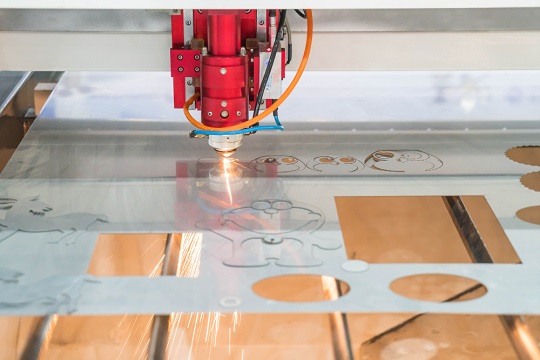
While medical applications are well known, many thulium facts point to broader uses of thulium-based lasers beyond healthcare. In industrial manufacturing, thulium lasers are used for precision cutting, welding, and surface treatment. Their 2 micrometer wavelength interacts efficiently with certain metals and polymers. This enables clean processing with minimal thermal distortion.
In aerospace and defense, thulium lasers support secure communication links, target designation, and range-finding. One reason for their popularity in these areas is that certain infrared wavelengths are considered "eye-safer" than others, reducing risk during operation. Additionally, thulium lasers can offer robust performance in challenging environments.
Thulium also plays a role in remote sensing and atmospheric monitoring. Researchers use thulium-based laser systems to measure pollutants, study weather patterns, and monitor environmental changes. These applications rely on the precise interaction between laser wavelengths and specific atmospheric components.

Thulium may be rare, but it still plays a meaningful role in modern electronics and optical systems. Many thulium facts relevant to this area focus on phosphors and optical coatings. Thulium is used in certain phosphors that emit blue light. This contributes to the color balance required in high-definition displays.
These phosphors are found in televisions, monitors, smartphones, and other display technologies where accurate color reproduction is essential. Even small variations in composition or impurity levels can affect brightness, color stability, and overall image quality.
Thulium-containing thin-film coatings and optical components are also used to improve light transmission and reduce reflection. These coatings enhance performance in cameras, scientific instruments, telescopes, and sensors.
|
Component
|
Function
|
Example End Products
|
|
Blue phosphors
|
Color emission
|
HD and 4K displays
|
|
Thin-film coatings
|
Anti-reflection
|
Optical lenses
|
|
Optical sensors
|
Transmission control
|
Scientific cameras
|
For electronics manufacturers, these thulium facts underline a key requirement: consistent optical performance depends on tightly controlled rare earth materials. This is why sourcing high-purity thulium oxides and compounds from experienced suppliers is critical.

Beyond commercial products, many thulium facts relate to advanced research and scientific exploration. Thulium participates in certain high-temperature superconductor systems, often in combination with elements like yttrium. These materials are studied for advanced electronics, power transmission, and experimental energy technologies.
Thulium is also used in nuclear science and analytical techniques. Thulium isotopes are used in neutron activation analysis to identify and measure elements in geological samples, mineral exploration, and even forensic investigations. This technique relies on precise nuclear properties that few elements can offer.
|
Area
|
Why Thulium Is Used
|
|
Nuclear science
|
Specific isotope behavior
|
|
Superconductors
|
Magnetic and energy levels
|
|
Analytical methods
|
High sensitivity
|
Research customers often face unique challenges. They need repeatable material properties, detailed documentation, and sometimes custom forms such as foils, sputtering targets, or nano-powders. These thulium facts highlight why research institutions value suppliers that can support both experimental work and future scale-up.
Thulium facts show that there is a clear pattern in the market. The demand for thulium is concentrated in niche, high-value applications rather than mass markets. Unlike cerium or lanthanum, thulium is not used in large volumes. Instead, it delivers outsized value in systems where performance requirements are strict.
The medical laser sector is one of the fastest-growing in the industry. It has projected growth of around 6% annually through the early 2030s. Thulium fiber lasers represent another promising area. Some market analyses estimate this segment has a growth above 9% per year driven by manufacturing and communications applications.
|
Segment
|
Trend
|
|
Medical lasers
|
Steady growth
|
|
Fiber lasers
|
Rapid expansion
|
|
Overall market
|
Niche, high value
|
For buyers, these thulium facts suggest that sourcing should be treated as a long-term strategic issue. Even small disruptions in supply can affect production schedules for high-value equipment.
Selecting the right form of thulium is just as important as choosing the right supplier. Common commercial forms include high-purity thulium metal (ingots, rods, foils, and pieces), thulium oxide and salts for phosphors and ceramics, and thulium-doped materials used in lasers and optical fibers. Advanced users may also require sputtering targets or nano-powders.
Key quality parameters include purity levels, trace impurity profiles, batch-to-batch consistency, and proper documentation such as certificates of analysis. These thulium facts are especially important for aerospace, medical, and electronics customers. This is because compliance and reliability are critical in these fields.
From a buyer's perspective, common pain points include intermittent availability, inconsistent purity, and difficulty scaling from lab quantities to industrial volumes. Working with a specialized rare earth supplier can help with these challenges. The supplier can provide technical guidance, flexible lot sizes, and stable long-term supply options.
What is thulium used for in everyday technology?
Thulium has widespread applications in the field of optics, particularly in fiber optic communication and laser technology. It can also help enhance image clarity in magnetic resonance imaging. Thulium also shows potential for applications in nuclear energy and solar cells. It is expected to contribute to the development of new energy technologies. These thulium facts show it supports many technologies people rely on indirectly.
Why is thulium so rare and expensive?
Thulium's abundance is only about 0.5 ppm, and it is produced mainly as a by-product. Complex separation and limited supply contribute to higher costs.
Is thulium safe to use in medical devices?
Non-radioactive thulium in solid components is handled like other specialty metals. Radioactive isotopes such as thulium-170 are used under strict regulatory controls.
Understanding thulium facts is only the first step. Turning that knowledge into reliable, high-performance products requires the right material quality, documentation, and supply strategy. Because thulium is rare, technically demanding, and often mission-critical, choosing an experienced rare earth specialist matters.
AEM REE works closely with engineers, OEMs, and research teams to provide high-purity thulium metals, oxides, and customized forms that meet exact technical requirements. Whether you are developing medical laser systems, optical components, electronic materials, or advanced research projects, AEM REE's thulium specialists can support you with material selection, data sheets, and stable long-term supply. Contact AEM REE today to discuss your thulium application and move from thulium facts to dependable real-world results.
 +86-731-89578196