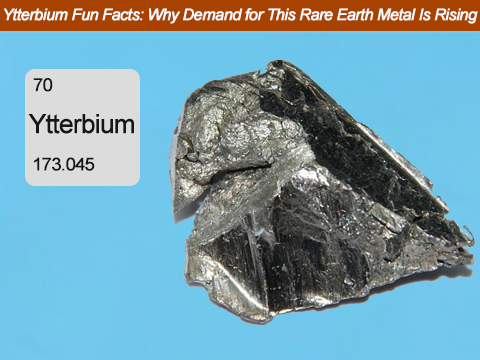
Quick takeaway: Ytterbium at a glance
Ytterbium fun facts often surprise people. This quiet element plays a major role in some of the world's most advanced technologies. Although people rarely talk about it outside of science, ytterbium metal is very important for lasers, atomic clocks, fiber-optic networks, advanced electronics, catalysts, and new energy systems.
Key facts table
| ltem | Key fact |
|
Element name
|
Ytterbium
|
|
Symbol
|
Yb
|
|
Atomic number
|
70
|
|
Element group
|
Rare earth metal (lanthanide)
|
|
Appearance
|
Soft, silvery-white metal
|
|
Standout traits
|
Extremely soft, pressure-sensitive, multiple allotropes
|
|
Main uses
|
Lasers, atomic clocks, telecom, electronics, catalysts, medical and energy technologies
|
These ytterbium fun facts explain why the global demand for this metal is increasing steadily in high-tech industries.
Ytterbium is a chemical element with the symbol Yb and atomic number 70. It belongs to the lanthanide series, which is commonly known as the rare earth metals. Among all rare earth elements, ytterbium metal stands out. This is due to its unusual softness, low melting point, and highly sensitive electronic behavior.
In simple terms, ytterbium is a silvery metal that looks calm and ordinary, but behaves in extraordinary ways. It is soft enough to be cut with a knife, reacts easily with air, and changes its electrical properties when pressure is applied. These traits make it valuable in scientific research and high-precision engineering.
One of the most interesting ytterbium fun facts is that it has one of the narrowest liquid temperature ranges of any metal. This means the temperature range between when it melts and when it boils is surprisingly small. Because of this, ytterbium metal behaves very differently from common metals like iron, aluminum, or copper.
Another key reason ytterbium matters is its electronic structure. The outer electrons of ytterbium atoms make it stable, predictable, and easy to control at the atomic level. This is why ytterbium is widely used in atomic clocks, quantum research, and laser systems. These fields need absolute precision.
Despite its importance, ytterbium remains almost unknown to the general public. Yet many modern technologies rely on it every day. Knowing these ytterbium fun facts helps explain why this rare earth metal is becoming more valuable every year.
Many ytterbium fun facts come directly from its unusual physical and electronic properties. For engineers, scientists, and manufacturers, these properties are extremely useful.
Ytterbium metal exists in three different structural forms, known as allotropes. These are called the alpha (α), beta (β), and gamma (γ) phases. Each form appears under specific temperature or pressure conditions. This is rare behavior, even among rare earth metals.
Ytterbium's ability to change structure makes it valuable in high-pressure physics and advanced materials research. This property allows scientists to study how metals behave inside planets or in extreme industrial conditions.
Another standout ytterbium fun fact is that it is very soft. Ytterbium has a density of about 6.9 g/cm³, making it one of the least dense lanthanides. Its melting point is around 824 °C, which is low compared to many other rare earth metals.
This softness makes it easy to shape, alloy, or process ytterbium metal in a laboratory or industrial settings. For research labs, this means easier sample preparation. For manufacturers, it allows controlled alloying and doping.
Ytterbium metal is also known for its pressure-sensitive electrical resistance. When pressure is applied, its electrical resistance changes sharply. Engineers use this behavior in ultra-precise pressure sensors and scientific instruments.
At room temperature, ytterbium is paramagnetic, meaning it weakly responds to magnetic fields. In certain compounds and conditions, it can even show superconducting behavior. These electronic properties are why scientists use ytterbium in advanced physics and electronics research.
Table: Ytterbium properties and why they matter
| Property | Ytterbium fun fact | Engineering relevance |
| Softness | Can be cut with a knife | Easy processing and alloying |
| Low density | Lighter than many lanthanides | Lightweight material design |
| Multiple allotropes | Three crystal structures | High-pressure research |
| Pressure-sensitive resistivity | Electrical resistance shifts sharply | Precision sensors |
These properties turn simple ytterbium fun facts into real engineering advantages.
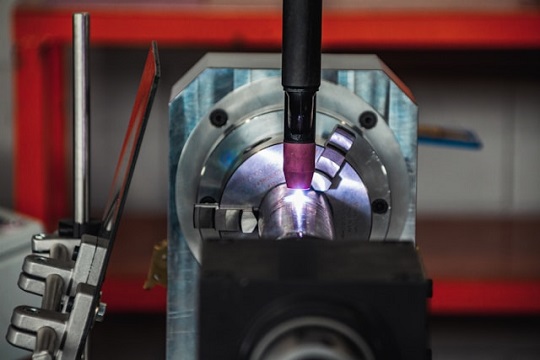
Some of the most impressive ytterbium fun facts come from laboratory research, where ytterbium metal is an important part of precision science.
Ytterbium is one of the most important elements used in optical atomic clocks. These clocks are so accurate that they would gain or lose only about one second over the entire age of the universe under ideal conditions. This level of precision is almost impossible to imagine.
Ytterbium atomic clocks are used for advanced research in timekeeping, satellite navigation, and fundamental physics. They help scientists test the laws of nature and improve global positioning systems.
Ytterbium metal is also widely used in quantum science. Researchers use ytterbium atoms to create ultracold quantum gases and Bose–Einstein condensates. These systems allow scientists to study quantum behavior in a controlled environment.
Because of its stable electron structure, ytterbium is easier to cool and control than many other elements. This makes it a preferred choice for quantum computing experiments and precision measurements.
Another key ytterbium fun fact is its role in fiber lasers. Ytterbium-doped fiber lasers are compact, energy-efficient, and powerful. They are widely used in industrial cutting, welding, marking, and medical devices.
These lasers offer high efficiency and excellent beam quality. As a result, they are replacing older laser technologies in many industries.
Ytterbium metal and its compounds are essential for producing these laser systems. This directly supports its demand growth across manufacturing and medical sectors.

Although you may not see it in advertisements, ytterbium is actually used in many technologies that we use every day. These lesser-known ytterbium fun facts show how deeply this rare earth metal is embedded in modern life.
Ytterbium plays an important role in advanced semiconductors. As electronic devices become smaller and faster, we need materials with precise electronic behavior. Ytterbium helps improve performance in memory chips and high-speed components.
In telecommunications, ytterbium-doped fiber amplifiers are critical. These amplifiers boost optical signals in fiber-optic networks, including undersea cables and global data infrastructure. Without ytterbium metal, long-distance, high-speed internet would be far less reliable.
Ytterbium compounds are also being studied for solar energy. Certain ytterbium-based materials can convert light more efficiently. This allows solar cells to capture a wider range of the solar spectrum. This research supports the global push for clean and renewable energy.
Ytterbium market growth at a glance
| Year | Market size (USD) | Notes |
| 2024–2025 | 100–110 million | Growing electronics demand |
| 2029–2030 | 164–182 million | Strong CAGR of ~10–10.5% |
| Fastest-growing region | Asia-Pacific | Electronics and telecom growth |
These everyday applications explain why demand for ytterbium metal continues to rise steadily.

Many industrial ytterbium fun facts are closely tied to manufacturing efficiency and performance improvement.
Ytterbium is used as a catalyst in polymer production. It's especially useful for plastics production like polyethylene and polypropylene. As a catalyst, ytterbium can improve reaction speed and control. This helps manufacturers reduce energy use and waste.
In metallurgy, small amounts of ytterbium are used as dopants in specialty alloys. Adding ytterbium metal can refine grain structure, improve mechanical strength, and enhance corrosion resistance. These benefits are valuable in aerospace, medical devices, and advanced industrial equipment.
Ytterbium compounds are also used in fine chemical and pharmaceutical synthesis. In these applications, ytterbium helps control reaction selectivity and improve yields. This makes production processes cleaner and more cost-effective.
For process engineers, one of the most practical ytterbium fun facts is that this metal can reduce production time, improve quality, and support more sustainable manufacturing methods.

Ytterbium fun facts also extend into medicine and energy, where precision and efficiency are critical.
In medical technology, ytterbium isotopes—especially Yb-176—are gaining attention. These isotopes are used or studied for nuclear medicine, imaging, and radiotherapy. Forecasts suggest that Yb-176-related markets may grow at around 15% per year over the next decade.
Ytterbium-based lasers are also important in medical procedures. They support minimally invasive surgery, precise tissue cutting, and advanced imaging systems. This improves patient outcomes while reducing recovery time.
In energy technology, ytterbium supports the development of high-efficiency solar cells and advanced power systems. Ytterbium metal helps create cleaner energy solutions by improving light conversion and electronic control.
Emerging ytterbium demand by sector
| Sector | Example use | Growth driver | Indicative CAGR |
| Medical | Imaging, radiotherapy | Precision healthcare | ~15% |
| Energy | Solar cells | Decarbonization | ~8–10% |
| Electronics | Sensors, optics | Miniaturization | ~10% |
These real-world impacts turn ytterbium fun facts into meaningful technology stories.
From a market perspective, ytterbium fun facts reveal a strong growth story. The global ytterbium market is projected to grow from roughly 100–110 million USD in the mid-2020s to around 164–182 million USD by the end of the decade.
Ytterbium oxide alone was valued at approximately 0.15 billion USD in 2024 and is expected to reach about 0.30 billion USD by 2034. This indicates strong demand for oxide-based products in electronics, optics, and advanced materials.
Growth is driven by electronics, fiber-optic telecom, medical imaging, and emerging quantum technologies. These sectors require high-purity materials and consistent supply. This increases the value of reliable ytterbium metal sourcing.
Featured answer: Ytterbium demand is growing at roughly 7–10% per year in many segments, driven by electronics, telecom, medical imaging, and energy technologies.
Despite its benefits, ytterbium metal requires careful handling. It oxidizes quickly in air and reacts with moisture. This means it must be stored in controlled, dry environments and handled with proper safety procedures.
For industrial and research users, purity and consistency are critical. Small variations in purity or form can affect performance in lasers, sensors, or catalysts. This is why sourcing ytterbium metal from specialized suppliers matters.
Common buyer challenges include long lead times, inconsistent quality, and limited availability of custom forms like foils, sputtering targets, or halides. Addressing these challenges requires an RFQ-driven, engineering-focused supply model.
For engineers and buyers exploring new ytterbium applications, working with an experienced supplier helps ensure material performance, documentation, and reliability.
| Fun fact | Real-world impact |
| Atomic clock accuracy | Ultra-precise timekeeping |
| Quantum gas behavior | Quantum computing research |
| Fiber laser efficiency | Industrial and medical lasers |
| Pressure sensitivity | High-precision sensors |
| Catalytic activity | Cleaner manufacturing |
| Medical isotopes | Imaging and therapy |
| Strong market growth | Long-term supply planning |
These ytterbium fun facts clearly show that ytterbium is no longer just an interesting rare earth element in textbooks. Today, ytterbium metal is used in technologies that need extreme precision, efficiency, and reliability. From atomic clocks and quantum research to fiber-optic telecom, medical lasers, advanced alloys, and clean energy systems, ytterbium has become a strategic material for modern industry and research.
As global demand continues to rise, one challenge becomes increasingly clear: sourcing the right ytterbium material matters just as much as understanding its properties. Engineers, procurement teams, and researchers need consistent purity, reliable performance, and materials supplied in the exact form required. This could be high-purity ytterbium metal, oxide, alloy, powder, foil, or other custom formats. Even small variations can affect results in sensitive applications like lasers, sensors, or experimental systems.
This is where working directly with experienced rare earth specialists makes a difference. At AEM REE, we support both industrial and research customers by supplying high-purity ytterbium materials. We do this through an engineering-focused, quote-driven model. Our technical team works closely with customers to understand application needs, purity requirements, dimensions, and delivery timelines. This helps reduce risk and shorten development cycles.
If you are exploring new designs, scaling up production, or simply evaluating whether ytterbium metal is the right solution for your application, our experts are ready to help. Share your requirements, challenges, or ideas with the AEM REE team. Let us support your project with the right ytterbium materials—designed for performance, consistency, and long-term success.
 +86-731-89578196