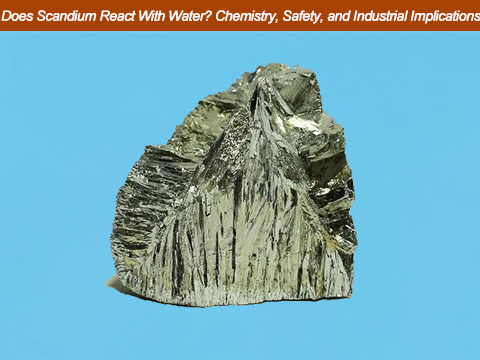
Key Takeaway – Direct Answer
Yes, scandium does react with water, but the reaction is generally slow at room temperature. Bulk scandium metal gradually reacts with water to form scandium hydroxide (Sc(OH)₃) and hydrogen gas (H₂). However, the reaction becomes noticeably faster when scandium is finely divided, heated, or exposed to fresh metal surfaces. In real engineering environments, the rate of reaction is often limited by the formation of a protective oxide layer on the metal surface.
Balanced reaction:
2Sc + 6H₂O → 2Sc(OH)₃ + 3H₂
For most industrial applications, the key point is that scandium does react with water. However, the reaction is controlled and manageable. Unlike highly reactive metals such as sodium or potassium, scandium does not violently react with water under normal conditions. Instead, its surface chemistry and oxide formation regulate how quickly water can interact with the metal.
Quick reference table
| Condition | Reaction Behavior |
| Bulk scandium at room temperature | Very slow formation of scandium hydroxide and hydrogen |
| Finely divided scandium powder | Faster reaction and visible hydrogen evolution |
| Elevated temperatures | Accelerated corrosion and hydroxide formation |
| Scandium in alloys | Reaction controlled mostly by the alloy matrix and oxide film |
Understanding whether scandium reacts with water and how quickly is important for engineers, researchers, and manufacturers working with rare earth metals. It affects storage, machining, corrosion control, and alloy design in industries ranging from aerospace to advanced electronics.
A common question in materials science is does scandium react with water. It's important for engineers evaluating its use in alloys, coatings, or research applications. The short answer is yes, scandium does react with water, but the reaction is generally slow and controlled.
When bulk scandium metal is exposed to water at room temperature, the reaction occurs gradually. The metal slowly forms scandium hydroxide, while hydrogen gas is released. Because the reaction rate is low, the process is usually not visible. It only becomes noticeable if the metal is exposed for a long time or if the conditions encourage corrosion.
However, the behavior changes under certain conditions. If scandium is ground into powder or filings, the total surface area increases dramatically. This allows water to interact with more exposed metal atoms, which speeds up the reaction. Likewise, higher temperatures can accelerate the chemical process, increasing hydrogen evolution.
For engineers and industrial users, this means scandium components are not easily damaged by casual moisture exposure. Instead, they behave similarly to other transition metals that develop protective surface layers. This property makes scandium practical for use in high-performance alloys and structural components.
Quick comparison of metal reactions with water:
| Metal | Reaction with Water |
| Sodium | Violent, explosive reaction |
| Magnesium | Slow reaction in cold water |
| Aluminum | Protected by oxide layer |
| Scandium | Slow reaction limited by passivation |
So when asking does scandium react with water, the right answer is that the reaction exists but is moderate and manageable. This is why scandium can be safely incorporated into many industrial materials.
To understand the question does scandium react with water, it helps to look at the underlying chemistry. Like many metals, scandium can undergo an oxidation reaction when it contacts water. During this process, scandium atoms lose electrons and form positively charged ions.
The balanced chemical reaction is:
2Sc(s) + 6H₂O(l) → 2Sc(OH)₃(aq) + 3H₂(g)
In this reaction, scandium metal reacts with water molecules to produce scandium hydroxide and hydrogen gas. The scandium atoms become Sc³⁺ ions. This means scandium typically forms trivalent compounds in aqueous chemistry.
Scandium hydroxide, written as Sc(OH)₃, often appears as a gel-like or gelatinous precipitate in solution. This material is only slightly soluble in water. Over time, it may transform into other scandium compounds. These include scandium oxide or scandium salts. The specific result depends on the surrounding chemical conditions.
For materials engineers and chemical researchers, the formation of scandium hydroxide has practical implications. In laboratory and industrial processes, precipitation of Sc(OH)₃ can affect:
• filtration systems
• pH control in solution chemistry
• downstream purification steps
• recovery of scandium compounds
Another important point is that scandium does react with water much less aggressively than alkali metals. Metals such as sodium release hydrogen violently. This is because they rapidly donate electrons to water molecules. In contrast, scandium's electron structure and metallic bonding slow this process.
Because of this moderate reactivity, scandium can be handled using standard precautions for transition metals rather than extreme safety protocols. This makes scandium easier to integrate into manufacturing processes where controlled aqueous environments may be present.
Many people first learning about metal reactivity ask does scandium react with water in the same explosive way as sodium. The answer is no. Although scandium does react with water, its behavior is dramatically different from the violent reactions seen with alkali metals.
The difference comes from several important chemical and physical properties.
First, alkali metals have extremely low ionization energies. This means they lose electrons very easily. When sodium touches water, electrons transfer rapidly to water molecules. This process produces heat, hydrogen gas, and a strong chemical reaction.
Scandium behaves differently because it is a transition metal. Its electrons are held more tightly, so electron transfer occurs much more slowly. As a result, the reaction with water proceeds at a controlled rate rather than instantly.
Second, scandium forms a stable oxide layer on its surface when exposed to air. This thin film acts as a barrier between the metal and surrounding chemicals, including water. The oxide layer limits how quickly water molecules can reach the metal surface.
Third, scandium's metallic bonding structure contributes to its stability. The atoms are held together strongly in the metal lattice, which reduces the tendency for rapid chemical breakdown.
The difference becomes clearer when comparing metal reactivity.
| Metal | Reaction with Water | Reaction Type |
| Sodium | Violent | Immediate hydrogen release |
| Potassium | Explosive | Highly exothermic reaction |
| Magnesium | Slow | Requires heat |
| Scandium | Moderate to slow | Limited by oxide layer |
Because of these factors, scandium can be used safely in engineering environments where occasional water exposure may occur. Understanding does scandium react with water and how strongly helps engineers choose materials. It allows them to balance performance with practical safety considerations.
One of the most important factors influencing the question does scandium react with water is the formation of a protective oxide layer on the metal surface.
When scandium is exposed to air, it quickly reacts with oxygen to form scandium oxide (Sc₂O₃). This oxide forms a thin but stable coating that adheres strongly to the underlying metal. The process is known as passivation, and it plays a major role in determining how scandium behaves in humid or aqueous environments.
The oxide layer acts as a physical barrier that prevents water molecules from directly contacting the metal surface. Because of this barrier, even though scandium can react with water chemically, the reaction rate is slowed dramatically in normal conditions.
This behavior is similar to that of aluminum. Aluminum forms an aluminum oxide film that protects the metal from corrosion in many environments. In fact, scandium's oxide layer behaves in a comparable way. This contributes to the stability of scandium-containing alloys.
However, the protective layer can sometimes be disrupted. For example, mechanical abrasion, machining, or cutting may expose fresh metal surfaces. When this happens, water can temporarily react with the exposed scandium until a new oxide layer forms.
In real industrial systems, several factors influence how well the oxide film protects the metal:
• temperature
• humidity levels
• chemical environment
• mechanical wear or friction
For engineers designing high-performance materials, understanding does scandium react with water in the presence of surface oxides is essential. In many cases, the protective oxide film allows scandium components to perform reliably even when occasional moisture exposure occurs.
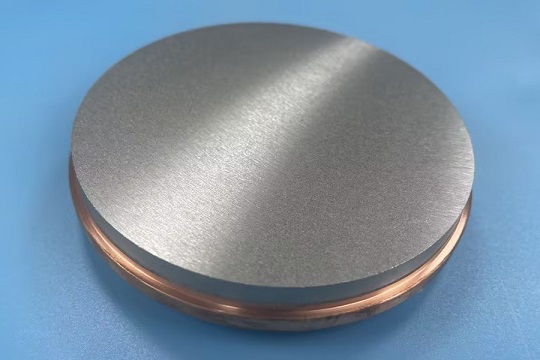
The question does scandium react with water is particularly important when scandium is used in alloys, especially aluminum-scandium (Al-Sc) alloys.
These alloys are widely studied in advanced engineering fields. The reason is that small additions of scandium can dramatically improve material performance. Typically, scandium is added in very small amounts, often less than one percent by weight. However, the effect on the alloy structure can be significant.
One of the primary benefits is grain refinement. Scandium promotes the formation of fine, stable grain structures within aluminum. This improves mechanical strength and reduces the risk of cracking during welding.
In addition, scandium additions help aluminum alloys resist recrystallization. This means the metal maintains its strength even at higher temperatures. This property is valuable in aerospace and transportation applications. In these fields, materials experience repeated heating and mechanical stress.
When considering corrosion or water exposure, the alloy's behavior is usually controlled by the aluminum matrix rather than the scandium itself. Aluminum already forms a strong protective oxide layer. This helps limit corrosion in many environments.
A simplified comparison illustrates the benefits.
| Property | Conventional Aluminum Alloy | Aluminum-Scandium Alloy |
| Yield strength | Moderate | Higher |
| Weldability | Moderate | Excellent |
| Grain stability | Lower | Significantly improved |
| Structural reliability | Good | Enhanced |
Because scandium content is small, the overall water reactivity of the alloy remains manageable. As a result, Al-Sc alloys combine high strength, lightweight performance, and stable corrosion behavior, making them attractive for aerospace structures, automotive components, and advanced manufacturing systems.
Since scandium does react with water, proper storage and handling practices are important for maintaining material quality and safety. Fortunately, scandium is not extremely reactive, so standard precautions are usually sufficient for most industrial environments.
The exact handling approach depends on the physical form of the material. Bulk metal pieces behave differently from powders or chemical solutions.
| Material form | Storage recommendation | Water interaction |
| Bulk metal ingots or rods | Store in dry sealed packaging | Very slow reaction with water |
| Powders or filings | Keep in low humidity or inert gas | Faster reaction and hydrogen release if wet |
| Aqueous scandium solutions | Store in labeled closed containers | Requires pH monitoring |
Bulk scandium metal is usually stored in protective packaging to minimize exposure to air and moisture. Because the reaction with water is slow, brief contact with humidity typically does not damage the material.
However, scandium powders and small particles require more attention. Their large surface area increases the rate at which they can react with oxygen and water vapor. Therefore, powders are commonly stored in sealed containers under dry air or inert gas to maintain purity.
In machining operations, chips or filings may accumulate during cutting or grinding. These metal fragments should not remain submerged in water or coolant for extended periods. Even though the reaction is slow, long-term contact may gradually produce hydrogen gas.
By understanding does scandium react with water and under what conditions, laboratories and manufacturing facilities can design storage systems that maintain material stability while ensuring safe operations.
Whenever engineers ask does scandium react with water, an important follow-up question concerns hydrogen generation. When scandium reacts with water, hydrogen gas is released as a by-product of the chemical reaction.
Hydrogen gas is highly flammable, and mixtures of hydrogen and air can become explosive when the hydrogen concentration reaches about 4 percent in air. Although scandium produces hydrogen slowly compared with more reactive metals, the gas can still accumulate in enclosed spaces.
In laboratory and industrial environments, this means that processes involving scandium and water should be designed with basic safety principles in mind.
Key safety practices include:
• providing adequate ventilation
• avoiding sealed containers where hydrogen could accumulate
• monitoring gas generation in large-scale systems
• preventing sparks or ignition sources near reaction areas
To understand the scale of the reaction, it helps to consider a simple example. If approximately 10 grams of scandium metal reacted completely with water, the theoretical hydrogen production could reach around 3 to 4 liters of gas at standard temperature and pressure.
While real industrial systems rarely allow complete reactions to occur, this example illustrates why gas release should be considered in process design.
Applications such as wet grinding, hydrothermal synthesis, chemical etching, or aqueous cleaning may all involve contact between scandium and water. In these cases, the reaction rate remains moderate, but good ventilation and proper process control ensure that hydrogen buildup does not create unnecessary risk.
Understanding does scandium react with water and how much hydrogen is produced allows engineers to design systems that are both efficient and safe.
For most applications, scandium is used in solid alloys or stable compounds, so the reaction with water is not the primary concern. However, there are several situations where engineers should carefully evaluate does scandium react with water and how the reaction might influence a process.
Machining operations are one example. Many metal components are cut or drilled using water-based coolants to control heat and improve tool life. When scandium alloys are machined in this way, the coolant may contact freshly exposed metal surfaces. The reaction rate remains slow, but proper chip management prevents long-term immersion of metal particles.
Another situation involves wet grinding or polishing. During finishing processes, fine metal particles may be suspended in water or slurry mixtures. Because finely divided scandium reacts more readily than bulk metal, engineers should ensure adequate ventilation and proper waste handling.
Chemical cleaning and etching processes may also expose scandium surfaces to aqueous solutions. These treatments can remove oxide layers or contaminants, which temporarily increases the metal's reactivity until a new oxide film forms.
Additional scenarios where water interaction matters include:
• corrosion testing in humid environments
• hydrothermal synthesis of scandium compounds
• thin-film deposition processes using scandium precursors
• recycling and recovery of scandium from industrial materials
By considering these conditions early in the design stage, engineers can maintain both performance and safety when working with scandium materials.
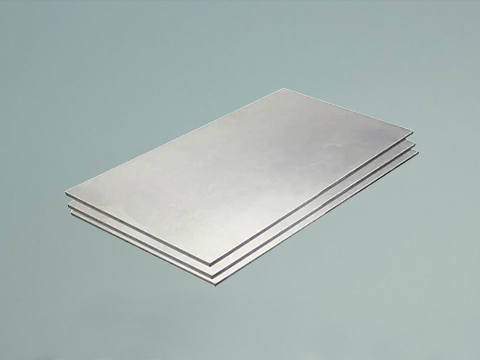
For companies exploring scandium technologies, understanding does scandium react with water is only one part of the materials selection process. Equally important is choosing the right form of scandium and integrating it into production systems effectively.
AEM REE specializes in supplying high-purity scandium materials to engineering teams, manufacturers, and research institutions around the world. The company provides a wide range of scandium products designed to support advanced materials development.
These materials include:
• high-purity scandium metal
• scandium oxide and chemical compounds
• aluminum-scandium master alloys
• customized particle sizes and powder forms
• sputtering targets and specialty materials for thin films
Beyond supplying materials, AEM REE also works closely with customers to help them understand how scandium behaves in real operating environments. For example, engineers may need guidance on how moisture exposure affects alloy processing, surface treatments, or cleaning procedures.
Technical documentation, such as certificates of analysis, impurity profiles, and handling recommendations, helps customers integrate scandium materials safely into their manufacturing lines. This consultative approach allows organizations to move from laboratory experiments to commercial production with greater confidence.
Whether the goal is developing lightweight aerospace alloys, exploring new electronic materials, or conducting advanced materials research, AEM REE supports customers with both reliable material supply and technical expertise.
Yes, scandium does react with cold water, but the reaction is slow. At room temperature, bulk scandium gradually forms scandium hydroxide while releasing small amounts of hydrogen gas.
Scandium and aluminum behave similarly in many environments because both metals form protective oxide layers. Finely divided scandium may react slightly faster than aluminum, but bulk metals remain relatively stable in water.
Yes. Standard machining coolants can usually be used when cutting scandium alloys. However, metal chips should not remain submerged in stagnant coolant for long periods because slow hydrogen generation may occur.
The main product is scandium hydroxide (Sc(OH)₃). This compound may later convert into scandium oxide or other scandium salts depending on the chemical environment.
Understanding does scandium react with water helps engineers, researchers, and manufacturers use this rare earth metal more effectively. As discussed, scandium does react with water, but the reaction is generally slow at room temperature and is often limited by the formation of a protective oxide layer. This controlled reactivity is one reason scandium can be safely used in advanced materials such as aluminum-scandium alloys, high-performance components, and specialized research applications.
For companies developing next-generation materials, selecting the right form and purity of scandium is essential. AEM REE supplies high-purity scandium metal, scandium oxide, alloys, and customized materials to support aerospace, electronics, energy, and research projects worldwide. If you are evaluating scandium for your application or need a reliable supply partner, our technical team is ready to help. Share your product specifications or project requirements with AEM REE to receive expert guidance and a tailored quotation.
 +86-731-89578196