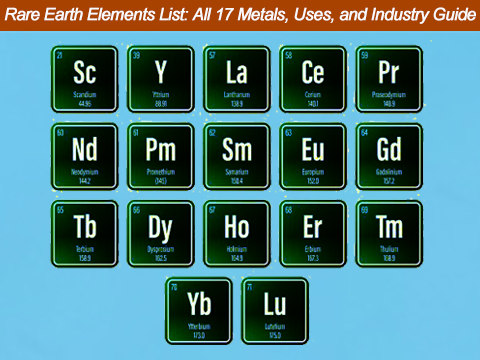
Rare earth elements are behind many of the technologies people rely on every day. From electric vehicles and aerospace systems to advanced electronics and medical imaging, these materials make modern innovation possible. However, most engineers and procurement teams searching for a rare earth elements list want quick answers first: which elements matter most and what roles they play in real-world applications.
This guide provides a clear and complete rare earth elements list. It explains the differences between the elements, and shows how they are used across industries. It also helps engineers and buyers understand which material forms—metals, oxides, alloys, or compounds—are best for production.
AEM REE is a specialized supplier and manufacturer. It provides rare earth metals, oxides, alloys, nano materials, and compounds. It supports global customers in aerospace, electronics, automotive, medical technology, and advanced manufacturing.
Key facts about rare earth materials:
| Key Insight | Details |
| Total rare earth elements | 17 metals |
| Groups | Light rare earth elements and heavy rare earth elements |
| Important for EV motors | Neodymium, Praseodymium, Dysprosium |
| Important for medical technology | Gadolinium, Lutetium |
| Common supply forms | Metals, oxides, alloys, salts, nano materials |
Many people search online for a clear rare earth elements list, and the answer is straightforward. The rare earth family includes 17 metallic elements. These consist of the fifteen lanthanides plus scandium and yttrium. Although these elements share similar chemical properties, their industrial roles can be very different.
Engineers often care less about chemistry classification and more about performance in applications. For example, some rare earth elements improve magnet strength, while others enhance optical performance, structural alloys, or catalysts. Understanding the complete rare earth elements list helps designers choose the right materials for manufacturing.
These elements are widely used because they offer unique magnetic, luminescent, catalytic, and structural properties that other materials cannot easily replace. As industries such as electric vehicles, renewable energy, semiconductor manufacturing, and aerospace continue to grow, demand for rare earth materials is increasing rapidly.
Another important point is that rare earth elements can be supplied in different forms. In many applications, companies do not use the pure metal itself. Instead, they use oxides, compounds, nano powders, or alloys depending on the manufacturing process and technical requirements.
Below is a quick reference table showing the full rare earth elements list and how each element is commonly used in high-value industries.
| Element name | Symbol | Typical application highlights |
| Lanthanum | La | Optical glass, camera lenses, catalysts |
| Cerium | Ce | Catalytic converters, fuel additives, glass polishing |
| Praseodymium | Pr | High-performance magnets, aerospace alloys, lasers |
| Neodymium | Nd | NdFeB magnets for EV motors, wind turbines |
| Promethium | Pm | Research applications, nuclear batteries |
| Samarium | Sm | SmCo magnets, nuclear control systems |
| Europium | Eu | Red and blue phosphors in displays |
| Gadolinium | Gd | MRI contrast materials, neutron shielding |
| Terbium | Tb | Green phosphors, magnetostrictive alloys |
| Dysprosium | Dy | High-temperature magnets |
| Holmium | Ho | Magnetic field applications, lasers |
| Erbium | Er | Fiber-optic communication amplifiers |
| Thulium | Tm | Portable X-ray equipment |
| Ytterbium | Yb | Specialty alloys and laser systems |
| Lutetium | Lu | PET imaging detectors |
| Scandium | Sc | Aluminum alloys for aerospace |
| Yttrium | Y | LEDs, ceramics, superconductors |
All materials in this rare earth elements list can be supplied in multiple product forms such as metals, oxides, alloys, or compounds. Selecting the correct form is often just as important as choosing the correct element.
When engineers review a rare earth elements list, they often notice that the elements are divided into two groups: light rare earth elements and heavy rare earth elements. This classification is important for both performance and supply chain planning.
Light rare earth elements are often called LREEs. They typically include lanthanum, cerium, praseodymium, neodymium, samarium, and europium. These elements are generally more abundant and are widely used in high-volume applications. For example, catalysts, glass manufacturing, polishing materials, and many types of permanent magnets.
Heavy rare earth elements are often referred to as HREEs. They include gadolinium, terbium, dysprosium, holmium, erbium, thulium, ytterbium, lutetium, and yttrium. These elements are less abundant and often more expensive. However, they are extremely important for advanced technologies that require high performance, thermal stability, or specialized optical properties.
For example, dysprosium and terbium are essential in high-temperature magnets used in electric vehicles and aerospace systems. Without these heavy rare earth elements, magnets may lose performance at elevated temperatures.
Understanding the difference between these groups helps companies manage costs and reduce supply risks. Engineers often try to optimize their designs to balance performance and material availability.
Here is a simplified comparison:
| Group | Typical elements | Common roles |
| Light REEs | La, Ce, Pr, Nd, Sm, Eu | Catalysts, polishing materials, magnets, glass |
| Heavy REEs | Gd, Tb, Dy, Ho, Er, Tm, Yb, Lu, Y | Lasers, high-temperature magnets, optics |
Companies that work with the full rare earth elements list often need a supplier that understands both technical performance and long-term supply stability. This is especially important for industries such as aerospace, EV manufacturing, and advanced electronics.
The full rare earth elements list includes materials used across many industries. However, not every element is used in the same way. Some are critical for magnets, while others are essential for optics, electronics, or structural alloys.
Below is a simplified overview that highlights the most important industrial uses of each group of elements.

Lanthanum and cerium are among the most widely used materials in the rare earth elements list. This is because they are relatively abundant and highly versatile. These elements are important in catalytic systems and glass manufacturing.
Cerium is widely used in catalytic converters and fuel additives. It helps reduce emissions and improve combustion efficiency in engines. Because of this, cerium plays a major role in environmental technologies.
Lanthanum is commonly used in optical glass and camera lenses. It improves clarity and durability in high-performance optical systems. Many advanced imaging devices depend on lanthanum compounds.
In manufacturing, lanthanum oxide and cerium oxide are also widely used for glass polishing and advanced surface finishing. These materials help achieve extremely smooth surfaces required in optics and electronics production.
Industries that frequently use these elements include automotive, chemical processing, glass manufacturing, and energy technology.

Praseodymium and neodymium are some of the most important materials in the modern rare earth elements list. They are especially useful for high-performance magnets. These elements are essential for producing NdFeB magnets. NdFeB magnets are widely used in electric motors, wind turbines, and robotics.
Electric vehicles rely heavily on neodymium magnets because they offer extremely strong magnetic fields while maintaining compact size and high efficiency. Without these materials, modern EV motors would be larger and less efficient.
Praseodymium is often combined with neodymium in magnet production to improve performance and stability. Even small changes in the composition of these materials can significantly affect the final magnet properties.
Because magnet performance is so critical, manufacturers often require very high purity materials and consistent quality. This is why many companies carefully evaluate suppliers when sourcing materials from the rare earth elements list.
Promethium is one of the least commonly used elements in the rare earth elements list. Unlike most other rare earth metals, promethium is radioactive and does not occur naturally in large quantities.
Because of this, promethium is rarely used in commercial manufacturing. Instead, it is mostly found in specialized research environments or nuclear energy applications.
One of its most interesting uses is in nuclear batteries, where it can generate power for long periods without maintenance. However, due to safety requirements and limited supply, most industries rely on other rare earth materials instead.
Including promethium in the rare earth elements list is important for completeness and scientific accuracy.

Samarium and europium play unique roles in the rare earth elements list. They contribute to both magnetic technologies and advanced display systems.
Samarium is best known for samarium-cobalt magnets, also called SmCo magnets. These magnets are extremely stable at high temperatures. They also resist corrosion better than many other magnet types. As a result, they are widely used in aerospace systems, defense technologies, and high-temperature environments.
Europium is very important in display technologies. It is used in phosphors that produce red and blue colors in screens, lighting, and LED systems. Without europium, modern displays would not achieve the same brightness or color accuracy.
Both elements are considered essential for advanced electronics and specialized manufacturing processes.

Gadolinium is one of the most valuable elements in the rare earth elements list for medical and scientific applications. It is widely used in MRI imaging technologies. This is because it improves contrast and helps doctors obtain clearer diagnostic images.
In addition to medical imaging, gadolinium also plays an important role in nuclear technologies. It has excellent neutron absorption properties. These properties make it useful in nuclear control systems and shielding materials.
Because these applications are highly sensitive, materials used in medical and nuclear fields must meet strict purity standards. Even small impurities can affect performance or safety.
This is why many laboratories and manufacturers require traceable and high-purity materials when working with elements from the rare earth elements list.

Terbium and dysprosium are extremely important for improving magnet performance. They are especially important in demanding environments. These elements from the rare earth elements list are often added to neodymium magnets to help them operate at higher temperatures.
Electric vehicles, aerospace equipment, and industrial motors often operate under challenging conditions. Without dysprosium or terbium, magnets may lose their strength when exposed to heat.
However, these elements are also among the most expensive rare earth materials because they are less abundant. As a result, many engineers try to optimize magnet designs to use smaller amounts while still maintaining performance.
Balancing cost, supply, and performance is one of the biggest challenges when working with the rare earth elements list in advanced manufacturing.

Several elements in the rare earth elements list are essential for optical technologies and laser systems. These include holmium, erbium, thulium, and ytterbium.
Erbium is widely used in fiber-optic communication systems. It helps amplify signals in long-distance internet and telecommunications networks.
Thulium is used in portable X-ray equipment and specialized laser technologies. These systems are important in medical and scientific applications.
Ytterbium is commonly used in laser systems and advanced alloys.
Holmium plays a role in magnetic calibration and laser devices.
Although these materials may be used in smaller quantities compared to other rare earth elements, they are extremely important for advanced technologies that require precise performance.

Lutetium is one of the heaviest elements in the rare earth elements list and is often used in advanced imaging technologies. It plays a key role in PET scanners and other medical diagnostic equipment.
In addition, lutetium compounds are used in specialized catalysts and scientific research applications. Even though the production volume is relatively small compared to other rare earth materials, lutetium is considered highly valuable.
Because it is rare and expensive, manufacturers need reliable supply chains and consistent material quality.

Scandium and yttrium have unique roles in the rare earth elements list because they contribute to both structural materials and electronics.
Scandium is widely known for improving aluminum alloys. When small amounts of scandium are added to aluminum, the resulting alloy becomes stronger, lighter, and easier to weld. This makes scandium-aluminum alloys very attractive for aerospace and high-performance engineering.
Yttrium is commonly used in LEDs, ceramics, superconductors, and electronic components. Many modern technologies rely on yttrium compounds to achieve high efficiency and durability.
These two elements are important because they help enable new materials that are stronger, lighter, and more efficient than traditional metals.
Understanding the rare earth elements list is only the first step. The next step is selecting the right element for a specific application. Engineers often start by identifying the function they need, such as magnet strength, optical performance, catalytic activity, or structural improvement.
Different industries rely on different elements from the rare earth elements list. For example, the electric vehicle industry depends heavily on magnet materials. Medical technology relies on imaging and optical elements.
Below is a simplified industry application guide:
| Industry | Common rare earth elements used |
| Aerospace | Sc, Nd, Dy, Tb, Sm, Gd |
| Electric vehicles | Nd, Pr, Dy, Tb, Ce, La |
| Medical technology | Gd, Ho, Tm, Lu |
| Electronics and optics | Eu, Y, Er, Yb, Nd |
| Catalysts and chemical processing | Ce, La |
When selecting materials, engineers must also consider purity levels, supply stability, and manufacturing compatibility. Sometimes a small change in material composition can significantly improve product performance.
Working with a knowledgeable supplier can help companies translate performance requirements into the right materials from the rare earth elements list.
Rare earth elements are rarely used in only one form. In fact, many materials from the rare earth elements list are processed into different product types depending on the manufacturing process.
Understanding these forms helps engineers select the best materials for their applications.
Metals are commonly used in alloy production, magnet manufacturing, and research applications. Examples include neodymium metal, samarium metal, and scandium metal.
Oxides are widely used in catalysts, ceramics, and polishing materials. Cerium oxide, europium oxide, and yttrium oxide are common examples.
Alloys and master alloys are engineered to improve mechanical properties in metals. Scandium-aluminum alloys are a well-known example in aerospace manufacturing.
Salts and compounds such as nitrates, chlorides, sulfates, and fluorides are important in chemical processing and deposition technologies.
Nano materials and sputtering targets are used in advanced electronics, coatings, and semiconductor manufacturing.
Here is a simplified comparison:
| Function | Typical form | Example elements |
| Magnet production | Metal or alloy | Nd, Pr, Sm |
| Catalysts | Oxide | Ce, La |
| Electronics and coatings | Nano materials | Y, Eu, Tb |
| Aerospace alloys | Master alloys | Sc, Nd |
| Optical materials | Oxides or compounds | Er, Yb |
This variety shows why companies often need access to the full rare earth elements list in multiple product forms.
Choosing the right supplier is just as important as selecting the correct materials from the rare earth elements list. For many industries, supply reliability and quality control directly affect production stability.
One of the most important factors is technical expertise. Suppliers should understand how each element in the rare earth elements list behaves in different applications. This knowledge helps engineers select the best materials for performance and cost efficiency.
Quality assurance is another key consideration. Many advanced industries require high-purity materials with strict documentation and traceability. Suppliers that operate under recognized quality systems can help ensure consistent material performance.
Customization is also valuable. Some manufacturers have specific requirements for particle sizes, alloy compositions, or packaging formats to ensure compatibility with their production processes.
Scalability is important as well. Many companies start with research quantities and later move into large-scale production. A reliable supplier should be able to support both stages.
Logistics and supply planning are increasingly critical. This is because rare earth materials can be affected by global market changes. Companies often prefer suppliers who can provide stable delivery and long-term supply support.
Organizations that work with the complete rare earth elements list often benefit from suppliers that offer technical guidance and global distribution capabilities.
What are the 17 rare earth elements?
The complete rare earth elements list includes lanthanum, cerium, praseodymium, neodymium, promethium, samarium, europium, gadolinium, terbium, dysprosium, holmium, erbium, thulium, ytterbium, lutetium, scandium, and yttrium.
Which rare earth elements are most important for electric vehicles?
Neodymium and praseodymium are the most important materials used in EV motors. Dysprosium and terbium are also used to improve magnet performance at high temperatures.
Do manufacturers always need the metal form of rare earth elements?
Not always. Many industries use oxides, compounds, or alloys instead of pure metals. The best choice depends on the manufacturing process and product requirements.
Why is promethium rarely used in industry?
Promethium is radioactive and very rare in nature. Because of this, it is mainly used in scientific research and specialized nuclear applications rather than commercial manufacturing.
How do I decide between light and heavy rare earth elements?
Light rare earth elements are usually used in larger-volume applications such as catalysts and magnets. Heavy rare earth elements are critical for advanced technologies that require higher performance or thermal stability.
The rare earth elements list includes 17 unique metals that support many of today's most advanced technologies. These elements are used in many industries, such as magnets, aerospace, medicine, and electronics. Each element has specific advantages that engineers and manufacturers rely on. Understanding the full rare earth elements list helps businesses select the right materials. This helps improve product performance, and manage supply stability.
However, choosing the correct element, purity level, and material form can be complex. This is where an experienced supplier becomes important. AEM REE provides high-purity rare earth metals, oxides, alloys, and compounds tailored to the needs of industrial customers, research institutions, and technology companies worldwide.
If you are evaluating materials from the rare earth elements list for a project or production requirement, our team is ready to help. Share your specifications or application details with us. we will recommend suitable materials and provide a reliable quotation for your needs.
 +86-731-89578196