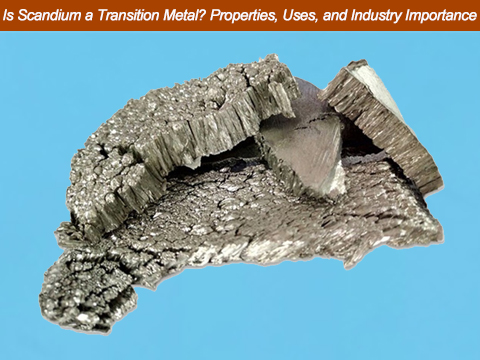
Many people ask, "is scandium a transition metal?" because scandium sits in an unusual position on the periodic table. Scientists and engineers often need a clear answer before selecting scandium materials. This is also true for alloy manufacturers and procurement teams. They require this information to ensure the material is suitable for industrial applications.
The short answer is yes. Scandium is commonly classified as a transition metal because it belongs to the d-block of the periodic table. However, some chemists debate this classification. This is because scandium's most stable ion, Sc3+, does not contain partially filled d-orbitals. Even with this debate, scandium remains an valuable material. It's essential for aerospace, energy, electronics, and advanced manufacturing industries.
Here are some important scandium facts at a glance:
| Property | Value |
| Element Name | Scandium |
| Symbol | Sc |
| Atomic Number | 21 |
| Classification | Commonly treated as a transition metal |
| Density | ~2.985 g/cm3 |
| Melting Point | ~1541°C |
| Boiling Point | ~2836°C |
| Common Oxidation State | +3 |
| Appearance | Silvery-white metal |
| Major Uses | Aluminum alloys, fuel cells, lighting, electronics |
Scandium may not be as widely known as titanium or aluminum, but it plays an important role in high-performance materials. Small additions of scandium can significantly improve alloy strength, weldability, and corrosion resistance. This is one reason why scandium materials attract attention. They are particularly popular in the aerospace and advanced engineering industries.
Scandium is a soft, silvery-white metallic element with atomic number 21. It is located in the d-block of the periodic table between calcium and titanium. Because of its position, many scientists group scandium with transition metals. At the same time, scandium is also associated with rare earth elements because it is often found together with rare earth minerals in nature.
The question "is scandium a transition metal" is important. This classification affects how scientists describe the element. It also influences how industries understand its behavior. Engineers and procurement teams often review material classifications. They do this before choosing metals for specific applications. These include aerospace parts and fuel cells. They also evaluate metals for electronics or high-temperature systems.
Scandium has several valuable physical and chemical properties. It is lightweight and corrosion resistant. It's also capable of improving the performance of aluminum alloys. Pure scandium is not used in large quantities. However, even small additions can create major improvements in industrial materials.
Scandium was first discovered in 1879 by Swedish chemist Lars Fredrik Nilson. The element was named after Scandinavia. Today, scandium remains relatively rare. It's difficult to produce compared with common industrial metals. Most scandium production comes as a byproduct from uranium, titanium, or rare earth processing operations.
Despite its limited availability, scandium has become increasingly important in advanced manufacturing. Aerospace companies value scandium for lightweight structures. Energy companies use scandium in solid oxide fuel cells. Electronics manufacturers also study scandium compounds for specialty applications.
Scandium appears in Group 3 and Period 4 of the periodic table. It is positioned at the beginning of the transition metal section. This location is one major reason why scandium is commonly considered a transition metal.
Its electron configuration is:
1s2 2s2 2p6 3s2 3p6 3d1 4s2
The presence of a d-electron supports the argument that scandium belongs to the transition metal family.
Scandium has become important because modern industries need lighter and stronger materials. Manufacturers constantly search for metals that improve efficiency while reducing weight.
Scandium offers several important benefits:
These advantages make scandium useful in aerospace, automotive, defense, energy, and electronics industries.
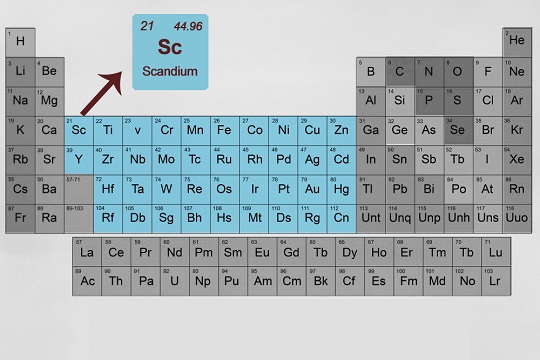
Yes, scandium is usually classified as a transition metal because it belongs to the d-block of the periodic table. However, the answer becomes more complicated under stricter chemistry definitions. Some scientists argue that scandium should not be considered a true transition metal. This is because its most stable ion, Sc3+, does not contain partially filled d-orbitals.
In most industrial and educational settings, scandium is treated as a transition metal. This definition focuses on scandium's position within the periodic table. It also considers the electron structure of the element in its neutral atomic state. Under this view, scandium clearly belongs to the transition metal group.
However, stricter chemistry definitions focus on ion formation. According to this interpretation, a transition metal must form at least one ion with an incomplete d-subshell. Scandium typically forms the Sc3+ ion with a d0 configuration. Thus some chemists exclude it from the transition metal category.
Even so, this debate is mostly academic. In practical industrial applications, scandium behaves similarly to many transition metals. It remains extremely valuable for alloy development and advanced materials engineering.
Several reasons support scandium's classification as a transition metal:
Because of these features, textbooks and industrial references often list scandium as a transition metal.
The disagreement comes from scandium's ionic behavior. When scandium loses electrons to form Sc3+, the remaining electron configuration no longer contains partially filled d-orbitals.
This creates a scientific debate:
| Definition Type | Is Scandium Included? | Reason |
| Broad Definition | Yes | Located in the d-block |
| Strict Definition | Sometimes No | Sc3+ has no incomplete d-shell |
This difference explains why some chemistry resources describe scandium differently.
At first glance, the question "is scandium a transition metal" may sound like a simple classroom discussion. However, the answer matters in industrial research, technical documentation, and advanced material development.
Scientists rely on accurate classifications when studying chemical behavior. They also use these classifications to analyze electron structures. Furthermore, accurate categories are essential for understanding alloy reactions. Researchers also use these classifications when publishing scientific papers or designing new compounds.
For industrial buyers, however, performance usually matters more than strict terminology. Aerospace engineers care about weight reduction. Manufacturers care about durability and corrosion resistance. Energy companies focus on conductivity and thermal stability. Scandium may not perfectly match every chemistry definition of a transition metal. However, this is often less important than its actual performance. The most critical factor is how the metal behaves in real-world applications.
Still, the classification question affects technical communication. Procurement teams reviewing material databases may encounter different descriptions depending on the source. Some references call scandium a transition metal directly. Others describe it as a rare earth-associated element with transition-like behavior.
This is why understanding the debate can help engineers and purchasing teams make more informed decisions. Accurate terminology improves communication between suppliers, researchers, and manufacturers.
Another reason the debate matters is education. Universities and research institutions may teach slightly different definitions. A broader definition focuses on periodic table placement. A stricter definition focuses on ion electron configurations. Both interpretations have scientific support.
In practical industry terms, scandium's classification does not reduce its value. Aerospace manufacturers, electronics companies, and advanced alloy producers continue using scandium. This is because of its outstanding material properties.
Industrial engineers focus on measurable performance factors such as:
Scandium performs well in many of these categories, especially when used in aluminum alloys.
Precise definitions remain important in:
Clear terminology helps reduce confusion during material selection and product development.
Scandium offers a unique combination of properties. It's low weight, high strength potential, and excellent thermal stability. These properties make it valuable in advanced engineering applications. In these fields, traditional materials may not provide the required performance.
The metal itself is relatively soft and lightweight. However, scandium becomes far more important when added to alloys. Even small scandium additions can improve grain refinement and strengthen aluminum structures significantly.
Here are some important scandium properties:
| Property | Description |
| Atomic Number | 21 |
| Density | ~2.985 g/cm3 |
| Melting Point | ~1541°C |
| Boiling Point | ~2836°C |
| Common Oxidation State | +3 |
| Appearance | Silvery-white |
| Corrosion Resistance | High |
| Conductivity | Good electrical and thermal conductivity |
People often ask, "is scandium a transition metal". One reason is that it shares many characteristics with transition metals. For example, it forms various compounds and participates in alloy systems. It also shows useful metallic behavior in industrial applications.
Scandium also provides strong heat resistance compared with lightweight structural metals. This makes scandium-containing materials useful in aerospace systems exposed to high temperatures.
Another valuable property is weldability improvement. Aluminum-scandium alloys often produce stronger weld zones with fewer structural weaknesses. This advantage is especially important in aircraft structures and lightweight transportation systems.
Scandium compounds also play important roles in fuel cells and specialty ceramics. In these applications, thermal stability and ionic conductivity become extremely important.
Scandium is attractive because it improves strength without adding excessive weight. This benefit is critical in aerospace and transportation industries where every kilogram matters.
Scandium-containing materials can resist oxidation more effectively than many traditional lightweight alloys. They also perform better at high temperatures. These properties make them more durable than standard alternatives.
Scandium compounds support stable operation in advanced technologies. They are used in fuel cells and specialty lighting. Additionally, they are essential for high-performance electronics.

Scandium may not be produced in large volumes, but it supports several high-value industries. Its most important commercial role is as an alloying element in aluminum.
Adding small amounts of scandium to aluminum improves the material. The resulting alloy becomes stronger and lighter. It also becomes more resistant to cracking and corrosion. This improvement makes aluminum-scandium alloys extremely attractive for aerospace applications.
Aircraft manufacturers constantly search for lighter materials. This is because reducing weight improves fuel efficiency and overall performance. Scandium alloys help achieve these goals while maintaining structural reliability.
Another growing application is additive manufacturing. Scandium-containing aluminum powders are increasingly used in metal 3D printing. These materials provide excellent strength and process stability. This helps manufacturers create lightweight aerospace and industrial components.
Scandium also plays a role in energy systems. Scandium-stabilized zirconia is commonly used in solid oxide fuel cells. These fuel cells require specific materials. These materials must remain stable under high temperatures. They must also support ionic conductivity
In lighting systems, scandium compounds are used in high-intensity metal halide lamps. These lamps produce bright, efficient light. The light is suitable for stadiums, industrial facilities, and specialized environments.
Electronics manufacturers also study scandium materials for advanced ceramic and semiconductor-related applications.
Scandium-aluminum alloys possess high strength, low density, and excellent corrosion resistance. They find applications in fields such as aerospace and automotive manufacturing.
Scandium-stabilized materials improve fuel cell efficiency and thermal performance. This technology supports clean energy development.
Scandium compounds help improve light quality and operational stability. These advantages are important in high-intensity lamps and specialty electronic systems.
Metal 3D printing continues expanding rapidly. Scandium alloys help manufacturers produce lightweight, high-strength printed components with improved durability.
For industrial buyers, the question "is scandium a transition metal" is often less important. They focus more on how scandium improves product performance and manufacturing reliability.
Aerospace companies need materials that reduce weight while maintaining strength. Aluminum-scandium alloys support this goal. They creates lighter structures with improved weld quality and better resistance to cracking.
Medical and imaging manufacturers value high-purity materials because performance consistency is critical. Precision materials help improve manufacturing quality and long-term reliability in sensitive systems.
Industrial manufacturers also benefit from scandium's ability. It can improve alloy stability and corrosion resistance. In demanding operating environments, stronger and more stable materials are favorable. They can extend product life and reduce maintenance costs.
Another important factor is process compatibility. Manufacturers need materials that work efficiently with existing production systems. These systems includes welding, machining, and additive manufacturing technologies. Scandium-containing alloys often perform well in these areas.
Supply reliability is also extremely important. Scandium is relatively rare. Therefore, procurement teams must carefully evaluate several factors before making purchasing decisions. They look at supplier capabilities and purity control. They also consider the level of technical support provided.
Industries continue to push toward lighter and stronger systems. They are also striving for greater efficiency. As a result, the demand for scandium may continue to grow. This trend is especially visible in aerospace, energy, and advanced manufacturing sectors.
Aircraft and spacecraft manufacturers seek materials that improve fuel efficiency. These materials must also maintain structural safety. Manufacturers prioritize both performance and security in their selection.
Medical technologies require materials with stable performance and controlled purity levels.
Manufacturers often prioritize:
Scandium is commonly classified as a transition metal because it sits in the d-block of the periodic table. However, it is also associated with rare earth elements. This is because it's often found in rare earth mineral deposits and shares similar chemical behavior.
Some chemists use a strict definition. They require transition metals to form ions with partially filled d-orbitals. Since Sc3+ has a d0 configuration, these scientists sometimes exclude scandium.
Scandium is mainly used in aluminum alloys, fuel cells, lighting systems. It's also used in advanced manufacturing technologies.
Pure scandium is generally considered weakly paramagnetic. It does not behave like strongly magnetic metals such as iron or cobalt.
Yes. Small additions of scandium can significantly improve aluminum alloy performance. It can increase strength and reducing cracking during welding.
So, is scandium a transition metal? In most scientific, educational, and industrial contexts, the answer is yes. Scandium is commonly treated as a transition metal because of its position in the d-block and its metallic behavior. However, some chemists continue debating the classification. This is because the Sc3+ ion lacks partially filled d-orbitals.
Despite this debate, scandium remains one of the most valuable advanced engineering materials available today. It has lightweight nature, corrosion resistance, thermal stability, and alloy-strengthening ability. These properties make it important across aerospace, energy, electronics, and manufacturing industries.
Demand grows for lighter and higher-performance materials. Scandium will likely continue attracting attention from engineers, researchers, and procurement teams worldwide. Reliable sourcing and purity control are becoming increasingly important. Technical support is also a vital factor. These elements are essential for companies using scandium products in advanced applications.
AEM REE supports industrial and research customers with high-purity scandium materials. We offer technical consultation and quote-based supply solutions for demanding applications worldwide.
Contact AEM REE to request scandium specifications, purity options, technical support, or availability information for industrial and research applications.
 +86-731-89578196