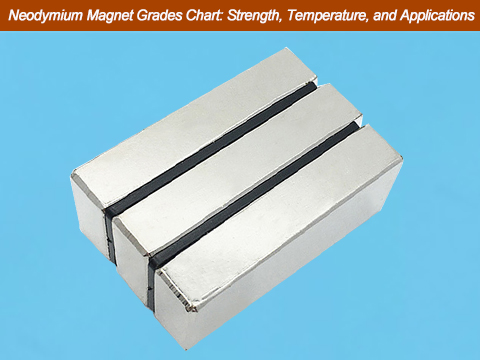
Neodymium magnets are known as the strongest permanent magnets widely available today. However, many buyers and engineers make the mistake of choosing magnets based only on strength without considering temperature resistance, operating conditions, or cost. In real industrial applications, selecting the wrong neodymium magnet grade is a serious error. It can lead to overheating and reduced performance. This mistake can also cause demagnetization, equipment failure, and unnecessary expenses.
The good news is that understanding neodymium magnet grades is not difficult. Once you understand how grades such as N35, N42, N52, SH, and UH work, you can choose a magnet that balances magnetic force, heat resistance, size, and budget more effectively.
Quick Definition:
Neodymium magnet grades describe the magnetic strength and temperature resistance of a magnet. Higher grades such as N52 provide stronger magnetic force, while suffixes like SH or UH indicate better heat resistance.
Below is a quick comparison chart of common neodymium magnet grades.
| Grade | Strength Level | Max Operating Temperature | Typical Applications |
| N35 | Standard | 80°C | General-purpose assemblies |
| N42 | Medium-high | 80°C | Electronics and motors |
| N52 | Highest common grade | 80°C | Compact high-force designs |
| N42SH | Medium-high with high heat resistance | 150°C | Industrial motors |
| N35UH | Moderate strength with excellent thermal stability | 180°C | Aerospace and sensors |
This guide explains how neodymium magnet grades work and how to compare them. You will also learn how to select the best option for your specific industry. This includes applications in aerospace, electronics, manufacturing, automation, and medical equipment.
Neodymium magnet grades are a classification system used to describe the magnetic strength and thermal resistance of neodymium magnets. These grades help people select the correct magnet for a specific application.
The most common neodymium magnet grades include N35, N38, N42, N45, N48, N50, and N52. In general, a higher number means a stronger magnet. For example, an N52 magnet provides greater magnetic force than an N35 magnet of the same size and shape.
The grade mainly reflects the magnet's maximum energy product, often called BHmax. This value measures how much magnetic energy the magnet can store. In simple terms, it indicates how powerful the magnet is.
However, stronger is not always better. Many industrial buyers assume that choosing the highest available grade automatically improves performance. In reality, high-strength magnets can cost more and may not perform well in high-temperature environments unless they also include special thermal-resistant suffixes.
For example:
This is why understanding neodymium magnet grades is critical for real-world industrial applications.
Quick Fact:
Higher neodymium magnet grades provide stronger magnetic force, but temperature resistance and operating conditions are often more important than maximum strength alone.
Today, neodymium magnets are widely used in:
Each of these applications has unique performance requirements. Choosing the correct neodymium magnet grade helps you meet these needs effectively. By making the right choice, you can improve efficiency, reliability, safety, and cost control.
Understanding the neodymium magnet grading system is important. This can help buyers avoid expensive mistakes and choose magnets more effectively. Although the system may look technical at first, it is actually straightforward once the basic structure is understood.
The letter "N" stands for neodymium. The number that follows indicates the magnet's maximum energy product. This value represents the magnetic energy density of the material.
For example:
The higher the number, the greater the magnetic strength. This allows engineers to create smaller and lighter designs without sacrificing performance.
For compact devices, stronger neodymium magnet grades are especially valuable because they reduce the required magnet size. This is important in industries such as electronics, aerospace, and medical technology where space is limited.
However, higher grades often come with higher material costs. In many cases, a lower grade can deliver sufficient performance at a lower price.
Besides strength ratings, many neodymium magnet grades also include suffixes that indicate heat resistance.
These suffixes are extremely important. It's because neodymium magnets can lose magnetic performance when exposed to excessive temperatures.
Here is a simple comparison:
| Suffix | Temperature Resistance | Common Applications |
| M | Moderate heat resistance | General motors |
| H | High heat resistance | Industrial equipment |
| SH | Super high heat resistance | Automation systems |
| UH | Ultra high heat resistance | Aerospace systems |
| EH | Extremely high heat resistance | Specialized industrial applications |
For example:
This is especially important in applications involving:
Without proper temperature resistance, a magnet can permanently lose magnetic strength.
Quick Answer:
SH, UH, and EH suffixes indicate how well neodymium magnet grades resist demagnetization under high temperatures.
Understanding both the strength number and thermal suffix is essential. This helps buyers selecting right neodymium magnet grades for industrial use.
One of the easiest ways to compare neodymium magnet grades is through a side-by-side chart. This allows engineers and procurement teams to quickly evaluate strength, operating temperature, and application suitability.
Below is a detailed neodymium magnet grades chart covering common commercial grades.
| Grade | Relative Strength | Max Operating Temperature | Typical Applications | Cost Level |
| N35 | Standard | 80°C | Fixtures, holding systems | Lower |
| N38 | Moderate | 80°C | Sensors, electronics | Lower-medium |
| N42 | Medium-high | 80°C | Motors, automation systems | Medium |
| N45 | High | 80°C | Compact devices | Medium-high |
| N48 | Very high | 80°C | Precision equipment | Higher |
| N50 | Extremely high | 80°C | High-performance motors | Premium |
| N52 | Highest common grade | 80°C | Compact high-force systems | Premium |
| N42SH | Medium-high with heat resistance | 150°C | Industrial motors | Higher |
| N35UH | Moderate strength with excellent thermal stability | 180°C | Aerospace systems | Premium |
This neodymium magnet grades chart highlights an important reality: stronger magnets are not always the best option.
For example:
In many industrial applications, thermal reliability matters more than maximum pull force.
For example, in an electric motor exposed to high temperatures, an N42SH magnet may deliver longer operational life than an N52 magnet. Similarly, aerospace systems often prioritize temperature stability over maximum magnetic energy.
Another factor to consider is cost efficiency. Premium neodymium magnet grades can significantly increase project expenses. If a lower grade meets performance requirements, choosing a stronger magnet may only add unnecessary cost.
When reviewing a neodymium magnet grades chart, buyers should evaluate:
A balanced approach usually delivers the best engineering and financial results.
Different applications require different neodymium magnet grades. There is no single "best" grade for every situation. Instead, the ideal choice depends on performance requirements, operating conditions, size limitations, and cost considerations.

For general-purpose industrial applications, N35 to N42 grades are often the most practical choice.
These magnets provide:
Applications include:
Many industrial buyers choose N42 because it offers a good balance between strength and affordability.

Applications with limited installation space often require stronger neodymium magnet grades.
N45, N48, N50, and N52 are commonly used when engineers need:
Industries using these grades include:
N52 is especially popular in compact high-performance designs because it delivers very strong magnetic force within a small volume.
However, these stronger grades may cost significantly more than standard grades.

Heat exposure is one of the biggest challenges for neodymium magnets. In high-temperature systems, standard grades may lose strength permanently.
This is why SH, UH, and EH grades are essential for:
Examples include:
| Application | Recommended Grade |
| Servo motor | N42SH |
| Aerospace sensor | N35UH |
| Industrial automation system | N42SH |
| Compact medical device | N52 |
| Magnetic separator | N42 |
Choosing the correct neodymium magnet grades improves performance, reliability, and operating lifespan while reducing maintenance risks.
Temperature Resistance: Two Perspectives—Material and Product
Many engineers select sintered NdFeB magnets based solely on the "maximum operating temperature" for a specific grade. They often use this single value as their primary design basis. However, in practice, you must evaluate temperature resistance from two distinct perspectives. These include the material level and the product level.
Temperature Resistance at the Material Level:
This refers to the upper temperature limit that a standard sample can withstand under standard testing conditions. This data is derived from standard samples of sintered NdFeB materials under specific test scenarios. It's used for comparative analysis across different material grades. For example, the maximum operating temperature for N35 material is 80°C, while for 35SH material, it is 150°C.
Temperature Resistance at the Product Level:
This refers to the actual upper temperature limit that a specific magnet can withstand, taking into account its particular geometry, magnetic circuit structure, and operating environment. The temperature resistance of NdFeB materials is influenced by several factors. These include product geometry, magnetic circuit closure, and the strength of external demagnetizing fields. Because of these variables, magnets of the exact same grade can behave differently. Their actual temperature resistance may change significantly once they are fabricated into different products.
Changes in Magnetic Properties at High Temperatures
The magnetic properties of sintered NdFeB magnets degrade as temperature rises. This is an inherent characteristic of the material. This characteristic manifests in two distinct ways:
Reversible Demagnetization:
Magnetic properties decline as the temperature rises. However, they essentially recover once the temperature returns to its original level. This occurs because thermal agitation causes a temporary disruption in the alignment of magnetic domains. The material's microstructure itself remains undamaged.
Irreversible Demagnetization:
High temperatures can cause lasting damage to magnetic properties. Even after the magnet cools back down to room temperature, these properties may fail to fully recover. This results in a permanent loss of magnetic strength. This is because the high temperature has caused an irreversible degradation of the magnetic domain structure.
Factor 1: Material Grade
The material grade serves as the fundamental determinant of temperature resistance. Sintered NdFeB magnet grades typically consist of a "number + letter suffix" combination—for example, 35SH or 42UH. The number represents the maximum energy product (measured in MGOe). The letter suffix denotes the temperature resistance class. It corresponds to specific ranges of intrinsic coercivity. The higher the intrinsic coercivity of a NdFeB magnet, the stronger the material's resistance to demagnetization and the better its thermal stability.
The material grade establishes the "theoretical upper limit" for thermal stability. It's determined by the intrinsic coercivity. However, selecting high-grade material is merely the beginning. You can still face major issues with thermal stability if the design is flawed. Specifically, a poor geometric shape can undermine the material's performance.
Factor 2: Magnet Shape
When designing, many engineers focus solely on a magnet's performance specifications. However, they often overlook a critical fact regarding NdFeB magnets. The geometric shape of the magnet significantly impacts its resistance to demagnetization. Specifically, the dimensional ratio along the direction of magnetization is a key factor.
During operation, a demagnetizing field is generated within the magnet. The strength of this demagnetizing field is closely correlated with the magnet's shape. The "flatter" the magnet, the stronger the demagnetizing field. Conversely, the "thicker" the magnet, the weaker the demagnetizing field.
In high-temperature environments, the intrinsic coercivity of NdFeB material naturally declines. If this decline is compounded by the presence of a strong demagnetizing field, irreversible demagnetization can easily occur.
Empirical data confirms this: for sintered NdFeB magnets of the exact same material grade, thin, wafer-like shapes exhibit vastly different demagnetization behaviors compared to thicker, more robust shapes when subjected to identical temperatures.
Therefore, the magnet's shape acts as an "internal factor" influencing the demagnetizing field. Even if an appropriate material grade is selected, an improper shape design (e.g., being excessively flat) will still severely compromise the magnet's actual thermal stability.
Factor 3: Magnetic Circuit Structure
In practical applications, NdFeB magnets invariably operate within a specific magnetic circuit environment. Variations in the magnetic circuit structure can significantly alter the strength of the demagnetizing field acting upon the magnet, thereby influencing its actual thermal stability.
The magnetic circuit structure serves as an "external factor" influencing the demagnetizing field. The exact same magnet may exhibit vastly different levels of thermal stability depending on the specific magnetic circuit environment in which it is situated. This explains one of the primary reasons why a product might experience "application failure" even when the "material itself is qualified."
Choosing the correct neodymium magnet grades requires balancing several important factors. The best magnet is not always the strongest one. Instead, the ideal solution depends on the application environment and performance requirements.
First, evaluate how much magnetic force the application needs.
Questions to consider include:
For general applications, N35 or N42 may be sufficient. For compact systems requiring maximum force, N50 or N52 may be better choices.
Temperature is one of the most important selection factors.
If the application operates in high-heat conditions, choose SH, UH, or EH neodymium magnet grades.
Examples include:
Quick Tip:
If a system runs hot, selecting a heat-resistant grade is usually more important than selecting the highest magnetic strength.
Compact systems often require stronger magnets because space is limited.
For example:
Higher neodymium magnet grades can reduce overall assembly size while maintaining magnetic performance.
Premium grades cost more. Therefore, buyers should avoid over-specifying magnets when lower grades can meet performance needs.
Here is a simple selection guide:
| If You Need… | Recommended Choice |
| Lowest cost | N35 |
| Balanced industrial performance | N42 |
| Compact high-force design | N52 |
| High-temperature operation | SH or UH grades |
A balanced decision helps improve product reliability while controlling manufacturing costs.
N52 is generally considered the strongest commonly available commercial neodymium magnet grade. It offers very high magnetic energy density and strong pull force in compact sizes.
N42 indicates the magnet's maximum energy product. Compared with lower grades such as N35, N42 magnets provide stronger magnetic force while maintaining standard operating temperature resistance.
No. N52 magnets provide stronger magnetic force, but they are not always the best choice. In high-temperature environments, lower-strength thermal-resistant grades such as N42SH may perform better.
SH, UH, and EH neodymium magnet grades are designed for high-temperature environments. These grades provide improved resistance to thermal demagnetization.
Both magnets have similar magnetic strength, but N42SH provides much better heat resistance. N42SH can operate safely at significantly higher temperatures.
No. Coatings mainly improve corrosion resistance and durability. Magnetic strength is determined primarily by the neodymium magnet grade itself.
Understanding neodymium magnet grades is essential for selecting the right magnet for industrial and technical applications. While stronger magnets such as N52 offer excellent magnetic force, maximum strength alone does not guarantee the best performance.
Temperature resistance, coercivity, operating environment, size limitations, and budget all play important roles in magnet selection. In many real-world systems, thermal stability and long-term reliability matter more than raw pull force.
From aerospace and medical devices to automation systems and electronics, choosing the correct neodymium magnet grades helps ensure stable and efficient operation.
AEM REE supplies high-performance NdFeB magnets and rare-earth materials for aerospace, electronics, manufacturing, medical, and advanced industrial applications. With experience in customized rare-earth solutions, AEM REE supports global customers with reliable quality, technical expertise, and specialized magnet options for demanding environments.
Whether you need standard N35–N52 magnets, high-temperature SH/UH grades, or customized NdFeB magnet solutions for specific industrial requirements, AEM REE can help you identify the most suitable option for your application. Our team works closely with engineers, manufacturers, research institutions, and procurement professionals to provide dependable magnet performance, stable supply, and tailored specifications.
If you are looking for high-quality NdFeB magnets for motors, sensors, automation systems, electronics, or precision industrial equipment, contact AEM REE today to discuss your project requirements and request technical support or a customized quote.
 +86-731-89578196