| Metric | Insight |
| Global recycling rate | Less than 1% of rare earth elements are recycled today |
| Potential supply impact | 25%–50% of demand could be met through recycling |
| Recovery efficiency | Up to 95% in advanced recycling processes |
| Energy savings | Up to 87% lower than primary production |
| Cost reduction | Up to 54% lower operating costs in some methods |
Recycling rare earth magnets is becoming a critical strategy for manufacturers. It allows companies to recover valuable elements such as neodymium and dysprosium from scrap and end-of-life products. Instead of losing these materials, businesses can reuse them to reduce costs, improve supply security, and support sustainable production. As global demand grows and supply risks increase, recycling rare earth magnets is no longer optional—it is a smart industrial decision.
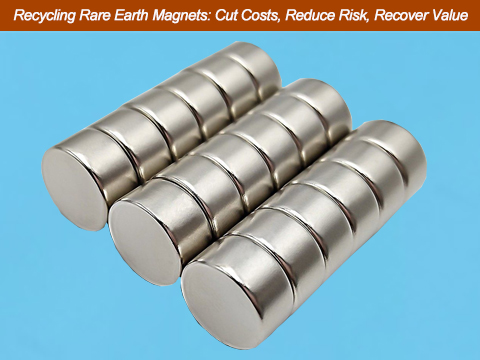
Rare earth magnets are powerful permanent magnets made from rare earth elements. The most common type is neodymium-iron-boron (NdFeB), which is known for its extremely strong magnetic force. Another type is samarium-cobalt (SmCo), which performs well in high-temperature environments. These magnets are essential in many modern technologies because they offer high performance in a compact size.
Recycling rare earth magnets begins with understanding their value. These materials are not only strong but also difficult to replace. Rare earth elements such as neodymium, praseodymium, and dysprosium are limited in supply and are often sourced from a small number of regions. This makes them both expensive and strategically important.
Rare earth magnets are widely used in many industries. Common applications include electric motors, wind turbines, medical devices, consumer electronics, and defense systems. For example, electric vehicles rely on NdFeB magnets for efficient motor performance. Wind turbines use them to generate clean energy. Even small devices like smartphones and headphones depend on these magnets.
Because of their importance, losing these materials through waste is costly. Recycling rare earth magnets helps recover valuable resources and reduces dependence on mining. This makes recycling a key part of modern material management and supply chain strategy.
Recycling rare earth magnets is not just about environmental protection. It is also a smart business decision for manufacturers. As global demand for rare earth materials increases, companies face growing challenges related to supply, cost, and risk. Recycling offers a practical solution to these issues.
One major reason to focus on recycling rare earth magnets is supply security. Many rare earth elements come from limited regions, which creates geopolitical risks. Disruptions in supply can affect production and increase costs. By recycling materials, manufacturers can reduce their dependence on external sources and build a more stable supply chain.
Another important factor is cost control. Rare earth materials are expensive and subject to price fluctuations. Recycling rare earth magnets allows companies to recover valuable materials from scrap and reuse them. This helps reduce raw material costs and improves overall efficiency.
Recycling also supports sustainability goals. Many companies are under pressure to reduce waste and lower their environmental impact. By reusing materials, manufacturers can reduce landfill waste and decrease the need for mining. This improves ESG performance and supports long-term business goals.
In addition, recycling enables closed-loop manufacturing. This means that materials from old products can be reused to make new ones. This approach improves resource efficiency and reduces waste.
In short, recycling rare earth magnets helps manufacturers reduce risk, control costs, and build a more sustainable and resilient business.
Recycling rare earth magnets involves several steps. Each step is designed to recover valuable materials and prepare them for reuse. While the process can vary depending on the method used, the general workflow remains similar.
The process starts with collecting magnet-containing products. These may include end-of-life motors, electronic devices, or industrial scrap. Proper collection is important to ensure a steady supply of recyclable materials.
Next, the materials are sorted and prepared. Magnets may be removed from products, demagnetized, or shredded into smaller pieces. This step helps improve efficiency in later stages.
After preprocessing, different materials are separated. For example, metals, plastics, and magnetic components are sorted. This helps isolate the rare earth magnet material for further processing.
In this step, rare earth elements are extracted using chemical, hydrogen-based, or electrochemical methods. This is the core stage of recycling rare earth magnets, where valuable elements are recovered.
Finally, the recovered materials are purified and converted into usable forms such as oxides, alloys, or new magnets. These materials can then be used in manufacturing again.
This step-by-step approach shows how recycling rare earth magnets turns waste into valuable resources. It also highlights the importance of process control and material quality in achieving high recovery rates.
Different recycling methods are used depending on the type of material and the desired outcome. Each method has its strengths and limitations. Understanding these options helps manufacturers choose the best approach for recycling rare earth magnets.
| Method | Strengths | Tradeoffs | Best Use Case |
| Hydrometallurgy | Mature, widely used | Uses chemicals, waste handling required | Large-scale industrial recycling |
| Acid-free dissolution | Lower environmental impact | Still developing commercially | Mixed electronic waste |
| Hydrogen processing | Energy-efficient, fast | Requires controlled feedstock | Magnet-to-magnet recycling |
| Electrified recovery | High purity, low emissions | Emerging technology | Advanced recycling systems |
Hydrometallurgy is one of the most common methods. It uses chemical solutions to extract rare earth elements. While effective, it requires careful waste management. Acid-free methods aim to reduce environmental impact, but they are still being developed.
Hydrogen processing is a promising approach. It allows magnets to be broken down and reused with lower energy consumption. This method is especially useful for direct magnet recycling.
Electrified recovery is a newer technology. It offers high recovery rates and lower emissions. Some studies report up to 95% recovery of rare earth elements using this method.
Choosing the right method depends on factors such as material type, scale, and cost. For manufacturers, selecting the right recycling strategy can improve efficiency and reduce environmental impact.
Recycling rare earth magnets offers clear economic benefits for industrial buyers. It transforms waste into a valuable resource and creates new opportunities for cost savings and efficiency.
One key benefit is reduced raw material costs. Rare earth elements are expensive, and their prices can change quickly. By recycling materials, companies can reduce their reliance on newly mined resources. This helps stabilize costs and improve financial planning.
Another advantage is supply chain resilience. Recycling rare earth magnets allows companies to create an internal source of materials. This reduces the risk of supply disruptions and improves production stability.
Recycling also enables companies to monetize scrap. Instead of treating waste as a cost, businesses can turn it into a source of value. This improves overall profitability and reduces waste management expenses.
In addition, recycling supports sustainability reporting. Many companies are required to track and report their environmental performance. Using recycled materials can improve these metrics and enhance brand reputation.
The rare earth recycling market is also growing. It is expected to increase significantly in the coming years, creating new business opportunities. Companies that invest in recycling rare earth magnets today can gain a competitive advantage in the future.
Many industries rely on rare earth magnets and can benefit from recycling them. Each sector faces unique challenges, and recycling offers solutions that improve efficiency and reduce costs.
In the aerospace industry, weight and performance are critical. Rare earth magnets are used in motors and control systems. Recycling rare earth magnets helps reduce material costs while maintaining high performance.
In the medical field, precision and reliability are essential. Devices such as imaging systems and surgical tools use rare earth magnets. Recycling ensures a stable supply of high-quality materials.
Manufacturing industries use magnets in automation systems and robotics. Recycling helps reduce costs and supports continuous production. It also allows companies to reuse materials from production scrap.
The electronics industry depends on small, powerful magnets for devices such as smartphones and speakers. Recycling rare earth magnets helps meet high demand while reducing environmental impact.
In the defense sector, reliability and supply security are critical. Recycling supports these goals by providing a stable source of materials.
Research institutions also benefit from recycling. They require high-purity materials for experiments and development. Recycling provides a cost-effective way to access these materials.
While recycling rare earth magnets offers many benefits, it also presents challenges. Understanding these challenges helps companies develop effective solutions.
One major challenge is collection. Rare earth magnets are often embedded in complex products. Removing them can be difficult and time-consuming. Improving product design and recycling systems can help address this issue.
Another challenge is material contamination. Recycled materials may contain impurities that affect quality. Advanced separation and purification techniques are needed to ensure high purity.
Feedstock variability is also a concern. Different sources of scrap may have different compositions. This makes processing more complex. Standardizing materials and improving sorting methods can help.
Cost is another factor. Recycling processes require investment in equipment and technology. However, as technology improves and scale increases, costs are expected to decrease.
To overcome these challenges, companies can work with experienced material suppliers and invest in advanced recycling technologies. Collaboration across the supply chain is also important.
The future of recycling rare earth magnets looks promising. As demand for rare earth materials continues to grow, recycling will play a larger role in meeting global needs.
One important trend is magnet-to-magnet recycling. This approach allows old magnets to be directly reused in new products. It reduces processing steps and improves efficiency.
Another trend is the use of advanced technologies. Artificial intelligence can improve sorting and material identification. Electrified processes can reduce energy use and emissions.
Local recycling facilities are also being developed. These facilities help reduce transportation costs and improve supply chain resilience. They also support regional manufacturing.
In addition, more companies are adopting circular economy models. This means designing products with recycling in mind. It improves resource efficiency and reduces waste.
Overall, recycling rare earth magnets is becoming a key part of modern manufacturing. It is no longer just a sustainability initiative but a strategic approach to securing materials and reducing costs.
AEM REE plays a key role in the rare earth value chain by supplying high-quality rare earth magnets and materials that support both primary production and recycling ecosystems. While AEM REE does not directly provide recycling rare earth magnets services, it helps manufacturers maintain a stable and reliable material supply in a market where recycled and virgin materials are often used together.
The company specializes in high-purity rare earth products, including rare earth metals, oxides, alloys, and magnets. These materials are essential for industries that rely on consistent performance and strict specifications. For manufacturers using recycled inputs, having access to reliable, high-quality materials is critical to ensure final product quality.
AEM REE also offers flexible customization options. This allows customers to source materials that match their exact technical requirements, whether they are working with newly mined resources or integrating recycled rare earth elements into their production processes. This flexibility is especially valuable in industries where material composition and purity directly affect performance.
In addition, AEM REE's experience in serving global industrial and research customers helps companies manage supply chain uncertainty. As recycling rare earth magnets becomes more important, manufacturers often need a trusted supplier to balance supply gaps and maintain production continuity.
By focusing on material quality, customization, and reliable delivery, AEM REE positions itself as a strong partner for companies navigating the evolving landscape of rare earth supply, including the growing role of recycling rare earth magnets.
Can rare earth magnets be fully recycled?
Yes, recycling rare earth magnets can achieve recovery rates of up to 90–95% using advanced technologies. This makes recycling a highly effective way to recover valuable materials.
What materials can be recovered from rare earth magnets?
Recycling rare earth magnets can recover elements such as neodymium, praseodymium, and dysprosium. These materials can be reused in new products.
Is recycling rare earth magnets cost-effective?
Yes, especially at large scale. Recycling reduces raw material costs and helps stabilize supply, making it economically beneficial for manufacturers.
What is NdFeB recycling?
NdFeB recycling refers to the process of recovering rare earth elements from neodymium-iron-boron magnets. It is one of the most common forms of recycling rare earth magnets.
 +86-731-89578196