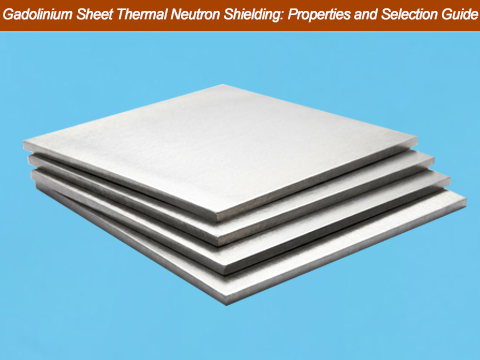
Gadolinium sheet thermal neutron shielding uses gadolinium metal as a neutron-absorbing layer. Natural gadolinium has an exceptionally high absorption cross section for thermal neutrons, making it useful when a compact absorber layer is needed. However, its suitability depends on neutron energy, material thickness, assembly geometry, and secondary radiation.
| Topic | Key Information |
|
Main function |
Absorbs thermal neutrons through neutron capture |
|
Natural gadolinium absorption cross section |
Approximately 49,700 barns at a neutron velocity of 2,200 m/s |
|
Important isotopes |
Gd-155 and Gd-157 |
|
Secondary radiation |
Neutron capture produces gamma-ray cascades |
|
Available material forms |
Gadolinium foil and sheet |
|
Main selection factors |
Neutron spectrum, thickness, purity, dimensions, geometry, and testing requirements |
Gadolinium sheet thermal neutron shielding can be considered for research equipment, neutron-related systems, and specialized absorber assemblies. This guide explains its working principle, material properties, product forms, and key purchasing considerations.
Thermal neutrons are low-energy neutrons that have reached approximate thermal equilibrium with their surroundings. They are common in moderated neutron systems and some research environments.
Gadolinium sheet thermal neutron shielding uses a flat layer of gadolinium metal to absorb these neutrons. When a neutron enters the material, a gadolinium nucleus can capture it. This process is called neutron absorption or neutron capture.
The ability of a material to absorb neutrons is often described by its neutron absorption cross section. A larger cross section generally means a greater probability of interaction under the same neutron-energy conditions.
One barn equals 10-24 cm². This unit describes the effective area used to express the probability of a nuclear interaction. It is not the physical size of an atom.
Gadolinium sheet is a material option, not a complete shielding design. The final assembly may also need structural support, gamma-ray shielding, suitable coverage, and application-specific testing. A sheet's performance cannot be confirmed from its material name or thickness alone.
In nature, the rare-earth element gadolinium typically exists in the form of non-toxic gadolinium oxide (Gd2O3). It possesses a remarkably high average thermal neutron absorption cross-section—reaching 36,300 barns—as well as high-temperature resistance and excellent gamma-shielding properties. Its property is mainly linked to two naturally occurring isotopes: gadolinium-155 (Gd-155) and gadolinium-157 (Gd-157).
At the reference neutron velocity of 2,200 m/s, the absorption cross-section values are approximately:
| Material or isotope | Thermal neutron absorption cross section |
|
Natural gadolinium |
49,700 barns |
|
Gd-155 |
61,100 barns |
|
Gd-157 |
259,000 barns |
These figures show why gadolinium is widely studied as a thermal neutron absorber. Gd-157 has an especially high absorption cross section. Both Gd-155 and Gd-157 contribute to the strong absorption behavior of natural gadolinium. These values are reference data, not measurements of a specific commercial sheet.
Chemical purity and isotope composition are different. A gadolinium sheet with 99.99% chemical purity contains at least 99.99% gadolinium by the stated purity measurement. This does not mean that the material is enriched in Gd-157.
Natural gadolinium contains several isotopes in their natural proportions. Isotopic enrichment requires a separate process and specification. Therefore, buyers should not assume that a high chemical-purity grade provides a higher-than-natural Gd-157 content.
For most material inquiries, it is important to confirm whether the application requires standard natural gadolinium or a specific isotopic composition.
Yes. Gadolinium does not simply capture a neutron and stop the process there. After neutron capture, the resulting nucleus is often left in an excited state. It releases energy through a series of gamma rays as it moves toward a more stable state.
This is known as a gamma-ray cascade. The total energy released is approximately:
These values represent the approximate total energy of the gamma-ray cascade, not the energy of one individual gamma photon. Research on thermal neutron capture by gadolinium describes these gamma-ray emissions and their importance in neutron detection.
This secondary radiation matters when engineers evaluate gadolinium sheet thermal neutron shielding. A material may absorb thermal neutrons effectively while producing gamma radiation that must also be considered.
The complete design may therefore need additional gamma shielding, suitable spacing, or other radiation-control measures. The required approach depends on the neutron source, surrounding materials, equipment layout, and acceptable radiation levels.
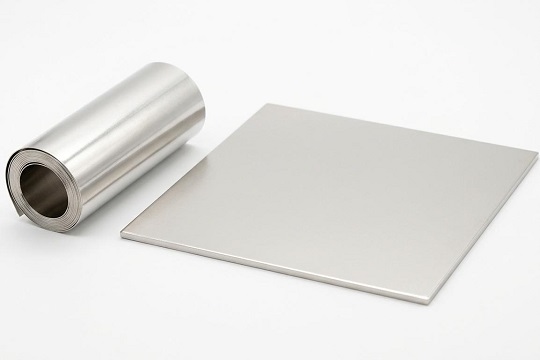
Gadolinium is available in different flat forms. The choice between gadolinium foil and sheet depends on the required thickness, dimensions, handling needs, and installation method.
AEM REE lists the following product specifications for its gadolinium foil and sheet. Confirm the final grade and dimensions with the supplier before ordering.
| Specification | Gadolinium foil | Gadolinium sheet |
|
Purity listed on dedicated product page |
≥99.99% |
≥99.99% |
|
Thickness range |
Minimum 20 μm |
0.5–40 mm |
|
Thickness tolerance or processing information |
Published processing accuracy: 2 μm |
±0.01 mm |
|
Listed dimensions |
Circular foil, Φ5–15 mm |
10–200 mm long × 10–150 mm wide |
|
Dimensional tolerance |
Confirm for requested size |
±1 mm |
|
Customization |
Available |
Available |
Specifications are based on AEM REE product information. Availability, tolerances, and applicable purity grades should be confirmed for the requested size and order.
Gadolinium foil is worth considering when a thin material layer is needed or when space and weight are important design factors. Its thin profile may also suit laboratory samples and specialized assemblies. However, thin foil may require careful handling and mechanical support.
Gadolinium sheet may be more suitable when a thicker, more rigid piece is required. It can be easier to handle and integrate into some equipment designs. Buyers should still consider the sheet's dimensions, surface condition, mounting method, and machining requirements.
Neither form is automatically better for neutron absorption. The correct choice depends on the required material thickness and the performance of the complete assembly.
There is no universal thickness for gadolinium sheet thermal neutron shielding. A suitable thickness must be determined from the actual application rather than selected from a general product description.
Engineers should consider these factors:
1. Neutron energy spectrum: Gadolinium has a very high absorption cross section for thermal neutrons, but neutron behavior changes with energy. The full spectrum must be evaluated.
2. Neutron flux: Flux describes the number of neutrons passing through a given area over time. The source strength and operating conditions affect the shielding requirements.
3. Required attenuation: The design team must define the acceptable neutron transmission or radiation level behind the absorber.
4. Material composition: Chemical purity and isotope composition can affect neutron absorption. Confirm whether natural gadolinium meets the application requirements.
5. Thickness and coverage: The material must have suitable thickness and cover the required area. Gaps, joints, openings, and edges can affect the result.
6. Secondary gamma radiation: Neutron capture produces gamma rays. Their contribution must be included in the overall radiation assessment.
7. Assembly geometry and testing: The surrounding materials, distance from the source, and equipment layout can influence performance. Simulation or testing may be needed to validate the final design.
A useful engineering review should record the neutron spectrum, source conditions, target attenuation, material grade, proposed thickness, coverage, and gamma-ray requirements.
Do not treat a thickness calculation based only on a single cross-section value as proof of real-world shielding performance. The final design should be evaluated under clearly defined conditions.
Gadolinium is one of several materials used or studied for neutron absorption. Boron, cadmium, and lithium are also important options.
The following table compares selected thermal neutron absorption cross sections:
| Material or isotope | Absorption cross section |
|
Natural gadolinium |
49,700 barns |
|
Natural cadmium |
2,520 barns |
|
Natural boron |
767 barns |
|
Lithium-6 |
940 barns |
|
Boron-10 |
3,835 barns |
Reference values are for thermal neutrons at approximately 2,200 m/s. Natural elements and individual isotopes are identified separately. Values are reference nuclear data, not equal-thickness shielding test results.
Gadolinium has a much higher thermal neutron absorption cross section than the natural elements listed above. This can make it attractive when a compact absorber material is being considered.
However, cross-section values alone do not determine which material is best. Engineers must also consider neutron energy, gamma-ray production, chemical and physical properties, corrosion behavior, material form, availability, cost, and fabrication requirements.
For example, boron-containing materials are used in many neutron absorber applications. Cadmium also has its own handling and material-selection considerations. The best option depends on the complete design and operating environment.
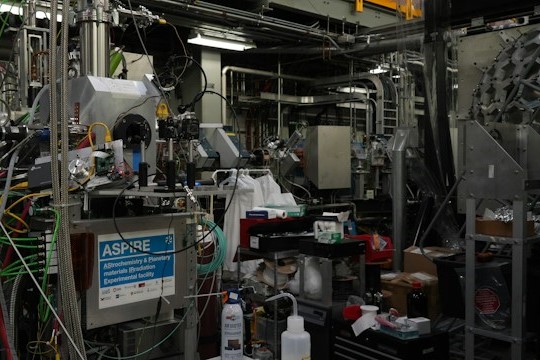
Gadolinium's strong thermal neutron absorption makes it relevant to several technical fields.
These examples show the range of neutron-related research and engineering involving gadolinium. They do not mean that every gadolinium sheet product is qualified for a specific nuclear facility or radiation-protection system.
When purchasing gadolinium sheet thermal neutron shielding material, buyers should provide clear technical requirements. A complete specification helps the supplier confirm whether the requested material can be supplied.
Important items include:
| Specification | Information to confirm |
|
Material form |
Foil, sheet, or another form |
|
Chemical purity |
Required purity level and measurement basis |
|
Isotopic composition |
Natural gadolinium or a specified isotope composition |
|
Thickness |
Nominal thickness and acceptable tolerance |
|
Dimensions |
Length, width, diameter, and dimensional tolerance |
|
Surface and edges |
Surface finish, flatness, edge condition, and visible defects |
|
Quantity |
Required number of pieces or total material weight |
|
Documentation |
Certificate of Analysis (COA), inspection records, and other agreed documents |
|
Application |
Intended use and any required testing conditions |
A Certificate of Analysis (COA) is an important document for checking the reported composition of a material batch. Buyers should confirm which elements and impurities are included in the analysis and whether the results meet their requirements.
AEM REE reports using GDMS, ICP-MS, and ONH analysis for batch composition and impurity testing. The specific test methods and report scope should be confirmed for each order. The company also lists COA documentation with shipments.
For applications with strict technical requirements, buyers may need additional inspection, traceability, or application-specific testing. A standard COA should not be treated as proof of nuclear qualification or validated shielding performance.
AEM REE supplies rare-earth materials for manufacturers, research laboratories, universities, and other technical buyers. Its product range includes gadolinium metal in foil, sheet and other forms.
Buyers can review the available gadolinium foil and sheet information and reach out to AEM REE to confirm product specifications, current availability, and customization options.
When sending an inquiry, include the material form, purity, thickness, tolerance, dimensions, quantity, surface requirements, and required documentation. It is also helpful to describe the intended application and any relevant testing conditions.
Providing a drawing or technical specification can help the supplier review the request and prepare a more suitable quotation.
Natural gadolinium has a very high thermal neutron absorption cross section, mainly due to Gd-155 and Gd-157. This makes it a useful material to evaluate when a compact thermal neutron absorber is required.
No. Its strong absorption is especially relevant to thermal neutrons. Performance depends on the neutron energy spectrum, material composition, thickness, and system design.
Yes. Neutron capture by Gd-155 and Gd-157 produces gamma-ray cascades. The resulting secondary radiation should be included in the design and safety assessment.
No. Chemical purity describes the amount of gadolinium and impurities in the material. Isotopic enrichment describes the proportion of a particular isotope, such as Gd-157.
Foil is generally thinner and may suit compact or lightweight assemblies. Sheet is available in greater thicknesses and may be easier to handle in some designs. The correct form depends on the application.
Include the required purity, thickness, tolerance, dimensions, quantity, surface condition, documentation, delivery destination, and intended application. Drawings and testing requirements are also helpful.
 +86-731-89578196