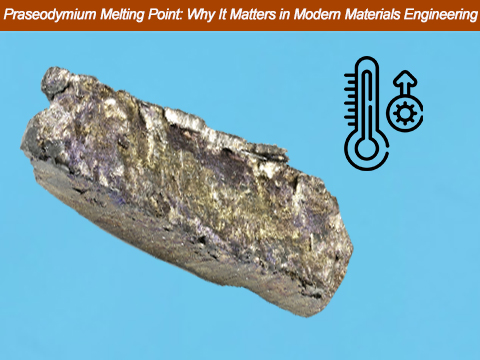
| Property | Value |
| Praseodymium Melting Point | 931°C (1204 K, 1708°F) |
| Boiling Point | ~3520°C |
| Atomic Number | 59 |
| Density | 6.77 g/cm³ (20°C) |
| Crystal Structure | Double Hexagonal Close-Packed (DHCP) |
| Common Industrial Forms | Metal, Oxide, Alloy, Sputtering Target |
Key Takeaway: The praseodymium melting point is 931°C (1204 K) under standard atmospheric pressure. This moderate temperature makes it great for alloys and permanent magnets. It also works well in specialty glass and thin films. Knowing this melting point is key for engineers, researchers, and buyers. It guides proper processing and ensures the best material choice for high-performance products.
Praseodymium (Pr) is a rare earth metal in the lanthanide series with atomic number 59. Although it is rarely used alone, it plays an important role in advanced materials. Praseodymium has distinct thermal properties. Its melting point directly affects alloy production and magnet manufacturing. It also plays a key role in other high-temperature processes. This article explains the key thermal properties of praseodymium. It shows why they matter and how they influence modern industrial applications.
The praseodymium melting point is 931°C (1204 K or 1708°F) at standard atmospheric pressure. This is the temperature at which solid praseodymium changes into a liquid.
For engineers and manufacturers, the praseodymium melting point is much more than a physical property. It determines how the metal behaves during melting, casting, alloying, and heat treatment. Knowing this value helps manufacturers select suitable furnaces. It also allows them to control processing temperatures effectively. Ultimately, this ensures they produce materials with consistent quality.
Praseodymium remains stable during many industrial heating operations. At the same time, it does not require the extremely high processing temperatures needed for refractory metals. This balance makes it practical for many manufacturing processes.
The praseodymium melting point is 931°C (1204 K or 1708°F). Its moderate melting temperature is a major advantage. It makes the metal suitable for permanent magnets and rare earth alloys. It also works well in specialty glass, sputtering targets, and other high-tech materials.
Many industries rely on the praseodymium melting point when designing production processes. For example:
Understanding this property improves production efficiency. At the same time, it reduces the risk of overheating or material loss.
The praseodymium melting point is often the most searched property. Meanwhile, engineers usually evaluate several thermal characteristics together.
| Property | Value | Why It Matters |
| Melting Point | 931°C (1204 K) | Determines melting and casting temperatures |
| Boiling Point | ~3520°C | Indicates stability at very high temperatures |
| Density | 6.77 g/cm³ | Influences component weight and alloy behavior |
| Atomic Weight | 140.91 | Basic physical property |
| Crystal Structure | DHCP | Affects mechanical behavior |
| Thermal Conductivity | Moderate | Supports heat transfer during processing |
| Electrical Resistivity | Moderate | Important for electronic applications |
The combination of these properties allows praseodymium to perform well in demanding industrial environments.
For example, the metal's relatively high boiling point is a major advantage. It ensures the material stays stable throughout high-temperature manufacturing. At the same time, the praseodymium melting point offers a convenient processing window. Teams can handle melting and alloy production without pushing furnace temperatures too high.
It is also important to remember that melting point alone does not determine material performance. Engineers also consider thermal conductivity, oxidation behavior, density, and compatibility with other alloying elements. Together, these properties influence product quality, manufacturing costs, and long-term reliability.
Praseodymium offers a great balance of thermal properties. Because of this, it has become an important material for many key industries. These include aerospace, electronics, renewable energy, and advanced manufacturing.
The praseodymium melting point influences nearly every stage of material manufacturing. Temperature control is critical during production. This applies whether manufacturers are making alloys, magnets, or thin films. Precise heating allows teams to achieve the exact material properties they need.
During manufacturing, metals are heated, mixed, cast, and cooled under controlled conditions. The praseodymium melting point determines the minimum temperature needed for these processes.
Typical production steps include:
Raw Material
↓
Melting
↓
Alloying
↓
Casting
↓
Heat Treatment
↓
Finished Product
If the temperature is too low, the material may not melt completely. If it is too high, oxidation and unnecessary energy consumption can occur. It is important to maintain temperatures close to the required range. Doing so helps improve production efficiency. It also ensures better overall product consistency.
The praseodymium melting point is moderate compared with many engineering metals. Therefore, manufacturers can process it using conventional industrial melting equipment. This simplifies production while reducing operating costs.
The praseodymium melting point also affects the final properties of many products.
Proper thermal processing helps manufacturers achieve:
These advantages explain why praseodymium is commonly added to advanced alloys rather than used as a pure metal. Even small additions can improve material performance when processing conditions are carefully controlled.
For engineers, understanding the praseodymium melting point is important. It helps optimize manufacturing parameters and reduce defects throughout production.
Comparing the praseodymium melting point with other rare earth elements provides valuable context. It shows where praseodymium fits within the lanthanide family and why it is widely used in industrial manufacturing.
| Rare Earth Element | Symbol | Melting Point (°C) | Typical Industrial Application |
| Cerium | Ce | ~795 | Glass polishing, catalysts |
| Praseodymium | Pr | 931 | Magnets, alloys, specialty glass |
| Neodymium | Nd | ~1024 | Permanent magnets |
| Samarium | Sm | ~1072 | SmCo magnets |
| Dysprosium | Dy | ~1407 | High-temperature magnets |
Compared with cerium, the praseodymium melting point is significantly higher. This gives praseodymium better thermal stability in many manufacturing processes. Compared with neodymium and samarium, praseodymium melts at a slightly lower temperature. This makes it somewhat easier to process while still maintaining excellent performance.
This moderate position offers several practical advantages:
These characteristics explain why praseodymium is frequently combined with neodymium in NdPr alloys. This combination is key for high-strength permanent magnets. It allows manufacturers to process the materials efficiently. It also delivers the exact thermal and magnetic properties required by modern tech. These materials power electric vehicles, wind turbines, industrial motors, and other advanced applications.
It is useful to compare the praseodymium melting point against other rare earth metals. This comparison gives engineers clearer insights. As a result, they can choose the right material based on exact operating temperatures and manufacturing needs.
The praseodymium melting point plays an important role in many advanced manufacturing industries. Praseodymium melts at 931°C. Because of this, manufacturers can process it efficiently while maintaining excellent material performance. This balance makes it extremely valuable in demanding conditions. It is ideal for products that require strength, stability, and reliability.

Permanent magnets are the largest application for praseodymium. Industry estimates show that 65–70% of global praseodymium demand goes toward NdFeB magnets. This is achieved through NdPr alloy production.
The praseodymium melting point is important during alloy melting, casting, and sintering. Stable thermal behavior helps manufacturers produce magnets with consistent composition and magnetic performance.
| Application | Why the Praseodymium Melting Point Matters |
| EV traction motors | Supports controlled alloy production |
| Wind turbine generators | Enables reliable magnet manufacturing |
| Industrial motors | Improves processing consistency |
| Robotics and automation | Contributes to stable magnetic materials |
Electric vehicles and renewable energy systems continue to grow. The demand for high-quality NdPr materials is expected to remain strong.

Praseodymium is also added to magnesium and aluminum alloys. These alloys are used in aerospace and other lightweight engineering applications.
Small additions of praseodymium can improve:
Praseodymium has a moderate melting point. This allows these alloys to be produced using conventional melting and casting equipment. At the same time, it helps achieve improved material performance.

Praseodymium compounds are widely used in specialty glass and advanced ceramics.
These materials are used for:
Praseodymium features distinct thermal properties linked to its melting point. These properties help manufacturers maintain stable processing conditions. This stability is crucial during both glass melting and ceramic firing.

Praseodymium metal and praseodymium oxide are also supplied as sputtering targets for physical vapor deposition (PVD).
These materials are used to manufacture:
In vacuum coating processes, predictable thermal properties are essential. Praseodymium's melting point and high boiling point work together seamlessly. They maintain stable conditions during deposition. As a result, manufacturers achieve high and consistent coating quality.

Praseodymium is also used in catalysts and specialty chemical products.
Its thermal stability supports applications such as:
Across all these industries, understanding the praseodymium melting point is important. It helps engineers optimize manufacturing processes while improving product quality and reliability.
Manufacturers must carefully control processing conditions. This helps them take full advantage of the praseodymium melting point. It also allows them to maximize its other thermal properties.
Praseodymium is chemically reactive, especially at elevated temperatures. During melting, exposure to oxygen can lead to oxidation.
To minimize oxidation, manufacturers commonly use:
These methods help preserve material purity and reduce contamination.
The praseodymium melting point offers a distinct processing advantage. It allows the metal to integrate smoothly into alloy systems. Most importantly, it achieves this without requiring extreme furnace temperatures.
Careful control of:
helps produce uniform microstructures and consistent mechanical properties.
Most praseodymium is processed as part of an alloy. However, manufacturers also machine metal ingots, rods, and custom shapes.
Proper machining practices help:
Praseodymium materials should be stored in clean, dry environments.
Good storage practices include:
Following these recommendations helps preserve product quality before manufacturing begins.
Like many rare earth materials, praseodymium should be handled using appropriate industrial safety procedures.
Praseodymium is generally considered to have low to moderate toxicity. However, dust, fumes, and fine particles generated during processing may present health risks.
| Potential Risk | Recommended Prevention |
| Metal oxidation | Process under inert atmosphere |
| Dust generation | Use local exhaust ventilation |
| High-temperature fumes | Wear appropriate respiratory protection |
| Eye or skin contact | Use gloves and safety goggles |
| Moisture exposure | Store in dry conditions |
During high-temperature operations, manufacturers should provide:
These measures help maintain safe working environments while supporting reliable manufacturing.
Understanding the praseodymium melting point is only part of selecting the right material supplier. Consistent quality, reliable supply, and technical support are equally important.
AEM REE specializes in supplying high-purity rare earth materials for industrial and research applications worldwide.
Our praseodymium product portfolio includes:
Customers choose AEM REE because we offer:
AEM REE provides premium praseodymium materials for demanding industrial uses. We serve projects in permanent magnets, aerospace alloys, thin films, and advanced research.
Get in touch with our technical team today. We can share product specifications, prepare custom grades, or help you plan your next praseodymium project.
The praseodymium melting point is 931°C (1204 K or 1708°F) at standard atmospheric pressure.
Praseodymium has a high boiling point of (approximately 3520°C). This demonstrates its excellent thermal stability during many industrial manufacturing processes.
Praseodymium has a moderately high melting point compared with many engineering metals. It provides an excellent balance between ease of processing and high-temperature performance. This makes it suitable for alloys, magnets, and specialty materials.
The praseodymium melting point determines appropriate melting, casting, and heat-treatment temperatures. Proper temperature control is essential for manufacturers. It helps them produce alloys with a consistent composition. It also leads to improved strength and reliable performance.
Yes. Praseodymium can react with oxygen at elevated temperatures. Manufacturers often process it under vacuum or inert gas to reduce oxidation and maintain material purity.
Praseodymium melts at 931°C, while neodymium melts at approximately 1024°C. Both elements are commonly combined in NdPr alloys used to manufacture high-performance permanent magnets.
Industries that benefit from the praseodymium melting point include:
 +86-731-89578196