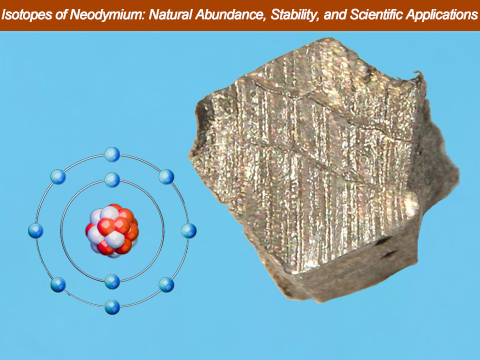
The isotopes of neodymium are seven naturally occurring forms of the rare earth element neodymium (Nd). These isotopes are 142Nd, 143Nd, 144Nd, 145Nd, 146Nd, 148Nd, and 150Nd. Among them, 142Nd is the most abundant, while 144Nd and 150Nd are radioactive with extremely long half-lives. This makes them effectively stable for most industrial and scientific applications. Today, the isotopes of neodymium play important roles across several fields. They are critical in geochemistry and isotope dating. They are also widely used in nuclear science and advanced materials research.
| Property | Value |
| Naturally occurring isotopes | 7 |
| Most abundant isotope | 142Nd (27.153%) |
| Long-lived radioactive isotopes | 144Nd and 150Nd |
| Main scientific application | Geochemistry and isotope dating |
| Common industrial relevance | Research materials, nuclear science, advanced materials |
The isotopes of neodymium are essential to both scientific research and advanced manufacturing. Although they share the same atomic number, each isotope contains a different number of neutrons. These small differences give them unique physical and nuclear properties. These distinct traits make them valuable for research and industrial uses.
Natural neodymium contains a mixture of seven naturally occurring isotopes. This blend works for most commercial applications. However, researchers sometimes require isotopically enriched materials. These enriched options improve measurement accuracy and help investigate specific nuclear processes. Understanding neodymium isotopes helps scientists choose the right analytical material. It also helps industrial buyers select products that meet demanding technical requirements.
In this guide, you will learn about the naturally occurring isotopes of neodymium. We will cover their abundance, stability, and key applications. You will also see why they matter in research and industry. Whether you work in a laboratory, a university, or advanced manufacturing, this overview will help. It provides a clear understanding of this important rare earth element.
Simply put, isotopes are different forms of the same chemical element. They all have the same number of protons but different numbers of neutrons. Because of this, their atomic masses are different, even though they behave almost the same chemically.
Neodymium has an atomic number of 60, meaning every neodymium atom contains 60 protons. The isotopes of neodymium differ only in the number of neutrons inside the nucleus. Scientists identify each isotope by its mass number, such as 142Nd or 150Nd.
Natural neodymium consists of seven naturally occurring isotopes:
Most industrial products use this natural isotopic mixture. It provides excellent performance across many applications. These include magnets, alloys, ceramics, and other engineering materials. In contrast, laboratories and research facilities often need a specific isotope. They require higher enrichment levels to perform precise scientific studies.
Understanding neodymium isotopes is essential across several advanced fields. These include geochemistry, isotope analysis, particle physics, and nuclear science. By measuring isotope ratios, researchers can trace complex geological processes. This data allows them to estimate rock ages and learn how Earth's crust and mantle evolved over billions of years.
Naturally occurring neodymium exists as seven distinct isotopes. Each isotope shares the same number of protons, but differs in its neutron count. This structural variation creates unique nuclear properties. These properties make the isotopes essential for geological dating, isotope research, analytical chemistry, and advanced science.
The isotopes of neodymium occur naturally in different proportions. Some are more common than others, and two are technically radioactive. Their radioactive decay is extremely slow. Because of this, they remain practically stable during most industrial and scientific work.
At a glance, 142Nd is the most abundant isotope. 144Nd and 150Nd have extremely long half-lives measured in quadrillions or quintillions of years.
| Isotope | Natural Abundance | Stability | Half-life | Typical Importance |
| 142Nd | 27.153% | Stable | — | Most abundant natural isotope |
| 143Nd | 12.173% | Observationally stable | — | Widely used in geochemistry |
| 144Nd | 23.798% | Radioactive | 2.29 × 10¹⁵ years | Effectively stable in practice |
| 145Nd | 8.293% | Observationally stable | — | Natural isotope |
| 146Nd | 17.189% | Stable | — | Common natural isotope |
| 148Nd | 5.756% | Stable | — | Minor natural isotope |
| 150Nd | 5.638% | Radioactive | 9.3 × 10¹⁸ years | Double beta decay research |
Every isotope contributes to natural neodymium. However, they are not equally important for scientific work.
142Nd is the most abundant and serves as the largest component of natural neodymium. Because it is so abundant, it acts as an important reference point. Scientists rely on it when studying the isotopic composition of natural samples.
143Nd is especially valuable because scientists measure the 143Nd/144Nd ratio to investigate the age and origin of rocks. This isotope is widely used in geochemistry and isotope dating.
144Nd is classified as radioactive, yet its half-life of approximately 2.29 × 10¹⁵ years is extraordinarily long. For comparison, this is hundreds of thousands of times longer than the age of human civilization. As a result, it behaves almost like a stable isotope during normal industrial use.
145Nd, 146Nd, and 148Nd are stable or observationally stable isotopes that naturally occur in smaller amounts. Together, they contribute to the overall isotopic balance found in natural neodymium.
Finally, 150Nd is another long-lived radioactive isotope. It represents only about 5.6% of natural neodymium. Despite its low abundance, it has attracted significant attention in particle physics. Researchers use it in studies of double beta decay. This process is essential for understanding the properties of neutrinos.
For most manufacturers, these natural abundance differences have little effect on product performance. However, for researchers performing isotope analysis or nuclear experiments, selecting the correct isotope can be essential.
A common question is whether the isotopes of neodymium are stable.
The answer is yes—mostly.
Natural neodymium is made of seven isotopes. Five are stable or observationally stable, while two are radioactive. However, those two radioactive isotopes—144Nd and 150Nd—have extremely long half-lives. Because their decay is so slow, they function as stable materials in almost all lab, industrial, and commercial settings.
To understand this better, start with the core distinction. You need to know the difference between stable isotopes and long-lived radioactive isotopes.
A stable isotope has never been observed to decay. An observationally stable isotope is predicted to decay by theory. However, no decay has been detected because the process would take an extraordinarily long time.
Natural neodymium includes two radioactive isotopes. These isotopes decay so slowly that their radiation is negligible in everyday work. Therefore, natural neodymium is safe to handle. It requires only standard laboratory and industrial safety precautions.
This exceptional stability is very important. It is one reason neodymium remains widely used in scientific instruments, rare earth materials, analytical standards, and advanced manufacturing. This stability also helps researchers measure tiny differences in isotope ratios. They can do this without significant interference from radioactive decay.
One of the most important scientific uses of the isotopes of neodymium is in geochemistry. Researchers analyze their isotope ratios to study Earth's history. They use this data to understand rock formation. It also allows them to trace material movement throughout geological systems.
The most widely used system is the samarium-neodymium (Sm-Nd) dating method. In nature, the radioactive isotope 147Sm slowly decays into 143Nd over time. By measuring the relationship between these elements, scientists can estimate the age of rocks and minerals.
The key measurement is the 143Nd/144Nd ratio. Different geological sources have different isotope signatures. This ratio helps researchers identify where rocks and sediments originally formed.
Common applications include:
Scientists use neodymium isotope ratios to estimate the formation age of geological materials.
Nd isotopes help researchers understand crust formation, recycling, and evolution.
Marine scientists analyze neodymium isotope variations to study past ocean movements.
Isotope fingerprints can reveal whether samples originated from different geological regions.
Neodymium isotopes serve as powerful tools. Their isotope ratios stay relatively constant through most geological events. That consistency is what makes them so reliable. This allows scientists to use them as natural records of Earth's history.
For example, consider a rock formed from Earth's mantle. It may have a different 143Nd/144Nd ratio compared to a rock formed from older continental crust. Researchers compare these key differences. By doing so, they can reconstruct geological events that happened millions or even billions of years ago.
A simplified process looks like this:
147Sm decay → 143Nd formation → Measure isotope ratio → Understand geological history
This application is mainly scientific. However, it demonstrates the vital importance of high-purity neodymium materials. Research institutions and analytical laboratories rely heavily on them.
Neodymium isotopes matter far beyond geological research. They support several other scientific fields. These include nuclear studies, isotope production, and advanced materials research.
Most industrial neodymium products rely on natural isotopic compositions. However, specific research projects have unique requirements. They may need individual isotopes or enriched neodymium materials.
| Isotope | Application | Field |
| 142Nd | Production of certain thulium and ytterbium isotopes | Nuclear science |
| 143Nd | Geological tracing and isotope dating | Geochemistry |
| 146Nd | Research related to potential Pm-147 production | Nuclear energy research |
| 150Nd | Double beta decay experiments | Particle physics |
Some isotopes of neodymium are valuable as starting materials in nuclear research. For example, scientists have studied 142Nd for producing short-lived isotopes. These include isotopes of elements like thulium and ytterbium.
Researchers have also investigated 146Nd as a possible material for producing promethium-147 (Pm-147). This is a radioisotope with potential applications in specialized energy systems.
The isotope 150Nd has attracted significant attention. This is because it can participate in double beta decay studies. These experiments help scientists explore fundamental questions about particle behavior. They also support research related to neutrino properties.
High-purity neodymium isotopes are essential in laboratory environments. They are especially useful when accurate measurements and controlled material properties are needed. Researchers often use isotope-enriched materials for specialized experiments. This occurs when natural isotope mixtures are not suitable.
Companies and research labs must choose the right materials for their work. Understanding how neodymium isotopes function helps guide this decision. It enables organizations to determine if standard neodymium is enough. Alternatively, it helps them decide if they need customized isotope compositions.
Natural neodymium contains seven naturally occurring isotopes. They exist in a fixed mixture. This composition works well for most commercial applications. These include rare earth magnets, alloys, ceramics, and general research materials.
However, some scientific applications require isotopically enriched neodymium. In these occasions, one specific isotope is increased above its natural abundance level.
The main differences are shown below:
| Feature | Natural Neodymium | Enriched Neodymium |
| Isotope composition | Natural abundance mixture | Increased concentration of a selected isotope |
| Availability | Widely available | Produced for specialized applications |
| Typical users | Manufacturers and general laboratories | Research institutes and specialized facilities |
| Cost | Lower | Higher due to processing requirements |
| Main applications | Magnets, alloys, chemicals, research | Nuclear studies, isotope experiments, advanced analysis |
The required form of neodymium also depends on the application. Research and industrial users may need materials in different chemical or physical forms, such as:
For example, a laboratory studying isotope behavior has specialized needs. It may require high-purity oxide or enriched materials. In contrast, a manufacturing company producing rare earth components has different needs. It typically requires standard neodymium metal or compounds.
When sourcing neodymium materials, buyers should consider several factors:
Choosing the correct material ensures better performance and more reliable research results.
Selecting the right neodymium product depends on the final application. Different industries require different forms, purity levels, and specifications.
A simple guide is shown below:
| Need | Recommended Neodymium Form | Typical Use |
| Magnetic materials | Neodymium metal | NdFeB magnet production |
| Chemical research | Neodymium compounds | Laboratory synthesis |
| Thin-film coating | Neodymium sputtering targets | Electronics and research |
| Optical applications | Neodymium oxide | Glass and laser materials |
| Isotope studies | Enriched neodymium materials | Scientific research |
For research institutes and advanced manufacturers, supplier capability is also important. Reliable sourcing requires consistent quality, accurate specifications, and technical support.
AEM REE provides high-purity rare earth materials, including neodymium products in various forms for research and industrial applications. With experience in rare earth metals, oxides, compounds, alloys, and customized materials, AEM REE supports customers who need reliable solutions for specialized projects.
There are seven naturally occurring isotopes of neodymium: 142Nd, 143Nd, 144Nd, 145Nd, 146Nd, 148Nd, and 150Nd. Five are stable or observationally stable, while 144Nd and 150Nd are extremely long-lived radioactive isotopes.
The most abundant isotope of neodymium is 142Nd, which makes up about 27.153% of natural neodymium. It is the largest component of the natural isotope mixture found in neodymium materials.
Most naturally occurring neodymium isotopes are stable or effectively stable. The isotopes 144Nd and 150Nd are radioactive. However, their extremely long half-lives make their radioactivity insignificant for most practical applications.
The isotope 143Nd is mainly used in geochemistry. Scientists analyze the 143Nd/144Nd ratio to study rock formation, geological history, crust evolution, and the sources of natural materials.
150Nd is important because it is studied in double beta decay experiments. These studies help scientists better understand nuclear processes and fundamental particle properties.
Yes. Isotope-enriched neodymium materials can be produced for specialized scientific applications. Requirements depend on the target isotope, enrichment level, material form, and research purpose.
The isotopes of neodymium provide valuable insights into Earth's history while supporting advanced research in nuclear science, analytical chemistry, and materials development. From the widely studied 143Nd isotope in geochemistry to specialized applications of enriched isotopes, each form of neodymium serves an important scientific purpose.
For most industrial users, selecting the right neodymium material involves considering purity, chemical form, and application requirements. AEM REE supplies high-purity rare earth metals, oxides, compounds, alloys, and customized materials for research institutions and high-tech industries worldwide.
If you need reliable neodymium materials or technical support for your next project, contact AEM REE to discuss your requirements and find a suitable solution.
 +86-731-89578196