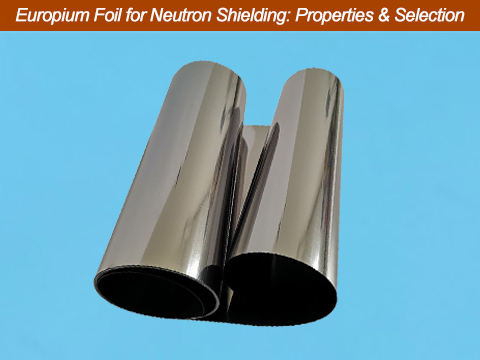
| Key Point | What Buyers Need to Know |
| Main function | Thermal-neutron absorption |
| Why europium? | High neutron-capture and absorption potential |
| Typical form | Thin metal foil for controlled material loading and layered designs |
| Key specifications | Purity, thickness, dimensions, isotope composition, and surface condition |
| Important limitation | Europium foil alone is not a complete fast-neutron shielding system |
| Best suited for | Research, material testing, neutron-absorption studies, and specialized shielding concepts |
Europium foil is a thin metal material. It can be designed for neutron shielding. It effectively absorbs thermal neutrons. This is because europium has a very high neutron-capture cross section. Its overall performance depends on several key factors. These include neutron energy, foil thickness, purity, isotope composition, and system geometry. In practice, europium foil should not be viewed as a universal standalone shield. Instead, it works best as an absorber layer within a larger engineered neutron-management system.
Europium foil is a thin, specified form of europium metal. For technical projects, buyers normally define it by purity, thickness, width, length, surface condition, and quantity.
The term "neutron shielding" can be misleading because neutron management involves several different functions. Fast neutrons may first need to be slowed by a moderator. After that, an absorber such as europium can capture thermalized neutrons. A separate material may also be needed to manage secondary gamma radiation.
Europium foil serves a specific purpose in neutron shielding. It is best used when a project needs controlled thermal-neutron absorption in a thin material form. This makes it ideal for several technical applications. It supports nuclear-material research and shielding development. It is also valuable for neutron studies, laboratory testing, and specialized absorber designs.
| Function | Main Purpose | Typical Material Role |
| Moderation | Slow fast neutrons | Hydrogen-rich material |
| Absorption | Capture thermal neutrons | Europium or other absorber |
| Gamma management | Reduce secondary gamma radiation | Separate shielding material |
Europium is attractive for neutron-absorption applications. This is because its nuclei have a high probability of capturing thermal neutrons. This probability is described by the neutron-capture cross section, measured in barns.
Natural europium has a reported thermal-neutron absorption cross section of about 4,530 barns. At thermal-neutron energy around 0.0253 eV, research indicates that neutron capture accounts for more than 96% of neutron interactions with europium.
Natural europium contains two main isotopes, Eu-151 and Eu-153. Their nuclear behavior is different. Therefore, isotope composition and neutron energy can affect actual performance.
Europium is a strong thermal-neutron absorber. Its naturally occurring isotopes have high neutron-capture probabilities at thermal neutron energies.
This makes europium foil for neutron shielding particularly interesting for research and specialized absorber designs. However, cross section alone does not determine the performance of a complete shielding system.
Several basic properties help engineers evaluate europium foil for a specific application.
Europium has an atomic number of 63 and a relative atomic mass of about 151.964. These values help determine the number of europium atoms present in a given mass of material. They are also useful in simplified absorption calculations.
Europium has a density of approximately 5.24 g/cm³. Density is important because it affects the number of absorber atoms contained within a given foil thickness.
The melting point of europium is approximately 822°C. This matters when foil is processed, heated, or integrated into systems exposed to elevated temperatures.
Natural europium consists mainly of Eu-151 and Eu-153. These isotopes have different neutron-interaction behavior. Therefore, isotope composition should be considered when precise nuclear performance is required.
Purity can be especially important for nuclear experiments, activation studies, detector research, and controlled material testing. Buyers may need impurity limits and analytical documentation in addition to a nominal purity value.
| Property | Europium Metal |
| Atomic number | 63 |
| Relative atomic mass | ~151.964 |
| Density | ~5.24 g/cm³ |
| Melting point | ~822°C |
| Natural isotopes | Eu-151, Eu-153 |
| Relevant neutron function | Thermal-neutron absorption |
Increasing europium foil thickness generally increases thermal-neutron absorption. However, there is no universal thickness for neutron shielding. The required thickness depends on a lot of factors. For example, neutron energy, material composition, geometry, and the required attenuation level.
A simplified attenuation relationship can be written as:
I/I₀ = e⁻Σₐt
Where:
Consider a simplified calculation using dense, natural europium exposed to thermal neutrons. A 0.10 mm foil can be modeled to absorb roughly 61% of incident thermal neutrons. Meanwhile, a 0.50 mm foil can be modeled near 99% absorption.
These values are illustrative calculations only, not certified shielding-performance data. Actual performance requires evaluation of the neutron spectrum, material composition, geometry, and system design.
When selecting europium foil for neutron shielding, engineers should also consider:
A thicker foil is not automatically the best solution. The material must be evaluated as part of the complete neutron-management system.
Europium foil offers a thin and highly controlled structure. Because of this, it is very useful for researchers. It allows them to use an exact amount of absorber material. It also helps maintain a precisely controlled test geometry.
Researchers can use europium foil to evaluate neutron-capture behavior. It allows them to compare different rare-earth absorber materials. This testing can be carried out under highly controlled conditions.
Europium foil can be investigated as an absorber layer in experimental multilayer shielding systems.
Defined foil samples can support neutron exposure, activation, and material-response experiments.
Europium and related materials are frequently studied in nuclear research. This is due to their unique neutron-absorption behavior. Such applications require project-specific nuclear analysis and qualification.
Small foil samples can provide a convenient and repeatable material form. These are important for laboratory testing and experimental assemblies.
Specialized research teams may evaluate europium-containing materials in neutron-related instrumentation and experimental systems.
Europium foil can serve as an absorber layer. It is typically combined with a neutron moderator. It can also be paired with a separate gamma-management layer.
Europium foil primarily absorbs thermal neutrons. It does not provide a complete solution for every neutron energy or radiation type.
Fast neutrons generally need to be slowed before efficient thermal-neutron absorption can occur. Hydrogen-rich materials such as polyethylene are commonly considered for neutron moderation.
After moderation, an absorber such as europium can capture thermalized neutrons. This is the primary role of europium foil for neutron shielding.
Neutron capture can produce secondary gamma radiation. Therefore, a complete shielding design may require another material or layer for gamma management.
A simplified multilayer concept is:
Fast neutron → hydrogen-rich moderator → europium absorber layer → gamma-management layer
The actual design must be determined through appropriate nuclear and engineering analysis.
Different absorber materials offer different combinations of nuclear, mechanical, thermal, environmental, and commercial properties.
| Material | Main Strength | Potential Advantage | Key Consideration |
| Europium | Strong thermal-neutron absorption | Thin metal foil and specialized research applications | Cost, activation, and application-specific validation |
| Gadolinium | Very high thermal-neutron absorption | Strong absorber performance | Isotope and capture behavior |
| Boron carbide | Established neutron absorber | Suitable for bulk and structural systems | Ceramic processing and form factor |
| Cadmium | Strong thermal-neutron absorption | Established absorber material | Safety, environmental, and regulatory considerations |
| Samarium | Strong neutron absorption | Rare-earth absorber option | Material and application requirements |
Gadolinium is widely recognized as an exceptionally strong thermal-neutron absorber. Europium is a strong choice under specific project conditions. It works best when you need its precise material form or composition. It is also valuable for its specific research characteristics or custom foil configurations.
Boron carbide is a well-known ceramic designed for neutron absorption. It serves a broad range of nuclear shielding applications. In contrast, europium foil is a metallic option. It works best for thin custom layers, lab coupons, and specialized research projects.
Cadmium and samarium also have strong thermal-neutron absorption characteristics. Making a final choice requires balancing technical and business factors. Key technical traits include absorption performance, activation products, corrosion, and processing. Safety, availability, cost, and regulatory requirements must also be evaluated.
The best neutron absorber is not always the material with the highest absorption value. Instead, it is the option that meets a project's full set of needs. It must satisfy nuclear, mechanical, and thermal requirements. It must also fulfill environmental and procurement demands.
A clear specification helps a supplier provide the right material and quotation. Technical buyers should gather key details before requesting europium foil. Preparing the following information in advance helps streamline the neutron shielding order.
Specify the required purity and, where necessary, individual impurity limits. Nuclear and research applications may require more detailed composition data.
Provide the nominal thickness and acceptable tolerance. Also state whether the project requires a single foil layer, multiple layers, or a specific total material thickness.
Provide the required foil dimensions or finished-part geometry. Custom dimensions are often essential. They are important when the foil must fit a specific laboratory fixture or test assembly. They are also needed for precise installation in a multilayer shielding structure.
State any requirements for surface cleanliness, smoothness, oxidation control, or handling condition. These details can become important when the foil will be used in controlled experiments or further processing.
Documentation requirements vary depending on the project. Buyers may require a Certificate of Analysis (CoA) and chemical composition data. They may also need impurity information, batch identification, or other material records.
Tell the supplier whether the requirement is for a laboratory sample, prototype, pilot quantity, or recurring production. This helps align material preparation and supply planning with the project's stage.
When requesting europium foil for neutron shielding, describe the intended use whenever possible. For example, state whether the foil is for neutron research, activation experiments, shielding development, detector research, or material testing.
AEM REE supplies high-purity rare-earth materials in customized forms. These materials serve industrial, research, and advanced-material applications. When ordering europium foil for neutron shielding, buyers can discuss several key details. They can review purity, foil dimensions, and quantity during the quotation process. Composition requirements, documentation, and sample needs can also be customized.
For a technical quotation, provide:
This information helps AEM REE better understand your material requirements. With these details, we can determine the most suitable supply solution for your project.
Europium foil works well for thermal-neutron absorption. Its effectiveness stems directly from europium's high neutron-absorption cross section. Even so, actual performance relies on multiple parameters. It is shaped by foil thickness, neutron energy levels, and material composition. The physical geometry and full system design also play crucial roles.
Europium foil is primarily useful for absorbing thermalized neutrons. Fast neutrons generally need to be moderated first, often with a hydrogen-rich material. Therefore, europium foil should not be treated as a standalone fast-neutron shield.
There is no single thickness that works for every neutron-shielding application. The required thickness depends on several factors. Key variables include neutron energy, target attenuation, and material composition. Geometry and the surrounding shielding system also play critical roles. Engineering calculations or testing should determine the final specification.
Europium foil should not be considered a standalone gamma shield. Neutron capture can generate secondary gamma radiation. Therefore, a complete shielding system may require additional gamma-management materials.
The required purity depends on several factors. First, consider your research objective and allowable impurities. Next, account for specific isotope requirements and activation concerns. Finally, factor in your project's documentation requirements. Buyers should specify these conditions when requesting a material quotation.
AEM REE can discuss custom europium requirements with you. Options include purity, thickness, width, length, quantity, and documentation needs. Buyers should provide their technical specifications and intended application. This allows AEM REE to evaluate the most appropriate material solution.
Europium foil for neutron shielding offers strong potential as a thermal-neutron absorber. It is ideal for research, material development, and testing. It also suits specialized shielding concepts. Its thin form allows for controlled material loading. This makes it easy to integrate into experimental or multilayer designs.
However, choosing europium foil requires more than looking at its neutron-capture cross section. Engineers need to analyze multiple system factors. First, evaluate the neutron spectrum, foil thickness, purity, and isotope composition. Next, consider activation behavior and system geometry. Finally, assess secondary radiation and environmental requirements.
Your project may require high-purity europium with defined dimensions and complete documentation. If so, AEM REE can assist you. We will review your technical specifications to build a customized supply solution. This service supports research projects, prototypes, and specialized material applications.
 +86-731-89578196