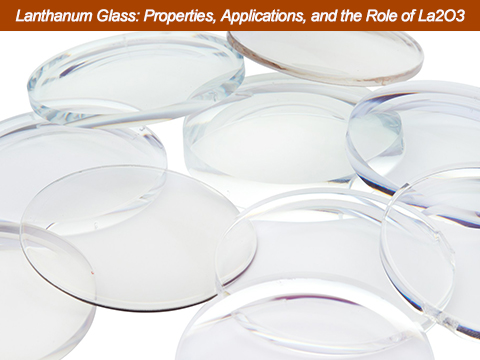
Lanthanum glass is a specialty optical material. It contains lanthanum, most commonly in the form of lanthanum oxide (La₂O₃). This glass is valued for its unique optical traits. La₂O₃ increases the refractive index while helping control dispersion. Consequently, lanthanum glass is ideal for compact, high-performance lenses. It's also used in scientific instruments, laser systems, and other precision optical components.
| Key point | What buyers should know |
| What is lanthanum glass? | Specialty glass containing lanthanum, usually through La₂O₃ |
| Why use La₂O₃? | It can increase refractive index and help control optical dispersion |
| Main advantage | Supports compact optical designs and chromatic-aberration correction |
| Common applications | Cameras, microscopes, telescopes, laser systems, and specialty glass |
| What determines performance? | Complete glass composition, processing, purity, and optical properties |
For optical-glass manufacturers, lanthanum glass is not simply a material with a high lanthanum content. Its performance depends on how La₂O₃ works with other glass-forming and modifying oxides. Therefore, selecting consistent, high-purity lanthanum oxide is an important part of developing reliable specialty glass.
Lanthanum glass is a family of specialty glass formulations. It contains lanthanum compounds, most commonly lanthanum oxide (La₂O₃). It is not one universal glass grade or a single fixed chemical composition.
A lanthanum glass formulation often includes multiple additives. It may contain silica, boron oxide, and alumina. Formulations can also include alkaline-earth oxides, zirconia, titanium oxide, or other rare-earth oxides. The final mixture determines key glass properties. It dictates refractive index, dispersion, and transmission. Thermal behavior and chemical durability also depend on this balance.
Common terms include:
| Term | Meaning | Typical purpose |
| Lanthanum glass | Glass containing lanthanum, usually through La₂O₃ | Specialty optical or technical applications |
| Lanthanum crown glass | High-index optical glass with controlled dispersion | Precision lenses and imaging |
| Lanthanum flint glass | High-index glass with tailored dispersion | Optical correction |
| Lanthanum borosilicate glass | La₂O₃-B₂O₃-SiO₂ glass family | Optical and specialty applications |
| Lanthanum oxide | La₂O₃ raw material | Glass formulation and property control |
Buying lanthanum oxide glass requires specific details. Manufacturers should not rely only on the general term "lanthanum glass". Instead, they should clearly define their required optical and chemical specifications.
Lanthanum oxide is a key additive in optical glass. It increases the material's refractive index. At the same time, it helps designers control optical dispersion. This combination provides greater optical power in a compact lens element. It also helps correct chromatic aberration in multi-element optical systems.
Key benefits of La₂O₃ in glass include:
However, La₂O₃ does not determine optical performance by itself. The complete glass formulation and manufacturing process must be designed around the required properties.
For technical buyers, the most useful way to evaluate lanthanum glass is through measurable specifications.
| Property | Why it matters | What buyers should specify |
| Refractive index | Determines how strongly the glass bends light | Target index and measurement wavelength |
| Abbe number | Indicates optical dispersion | Required dispersion range |
| Partial dispersion | Supports advanced optical correction | Required partial-dispersion relationship |
| Transmission | Determines usable wavelength range | UV, visible, NIR, or other range |
| Homogeneity | Affects image and wavefront quality | Permitted index variation |
| Defect level | Affects optical quality and production yield | Bubbles, inclusions, and striae |
| La₂O₃ purity | Helps control contamination | Assay and trace-impurity limits |
| Thermal properties | Affect forming and assembly | CTE and softening behavior |
Refractive index describes how strongly a material bends light. A higher index gives optical designers more flexibility. They can achieve the desired optical power using a smaller lens element. It also allows them to use a differently shaped element.
The Abbe number describes how strongly the refractive index changes with wavelength. Controlling dispersion is important when designing optical systems that must reduce color fringing.
Transmission determines which wavelengths can pass through the glass effectively. Homogeneity is also critical for precision optics. This is because local changes in refractive index can affect image quality.
For example, published lanthanum glass formulations vary widely. They show different combinations of refractive index and Abbe number. These values highlight the design range of specific compositions. They do not represent universal specifications for every lanthanum glass.
Lanthanum glass occupies a specific position within the wider optical-glass family. It should not automatically be considered better than conventional crown, flint, or ED glass.
| Glass type | Typical positioning | Main advantage | Key consideration |
| Conventional crown | Lower/moderate index, relatively low dispersion | Widely available and economical | May limit compact designs |
| Conventional flint | Higher dispersion | Useful for optical correction | Greater dispersion |
| Lanthanum crown | High index with controlled dispersion | Compact precision optics | Requires controlled formulation |
| Lanthanum flint | High index with tailored dispersion | Advanced optical correction | More complex formulation |
| Lanthanum borosilicate | Tunable optical and physical properties | Specialty optical applications | Strongly formulation-dependent |
The right choice depends on the complete optical design. Lens manufacturers must evaluate several key factors. First, examine optical traits like refractive index, Abbe number, and partial dispersion. Next, assess transmission and thermal properties. Finally, weigh manufacturability and overall cost.
The combination of refractive index and controlled dispersion makes lanthanum glass useful in several precision applications.

Photographic objectives: Widen the field of view, reduce lens weight, and increase shooting speed.
Microscopes: Enhance resolution and image quality, suitable for high-precision scientific research and observation.
Telescopes: Optimize optical systems, reduce aberrations, and improve observation performance.
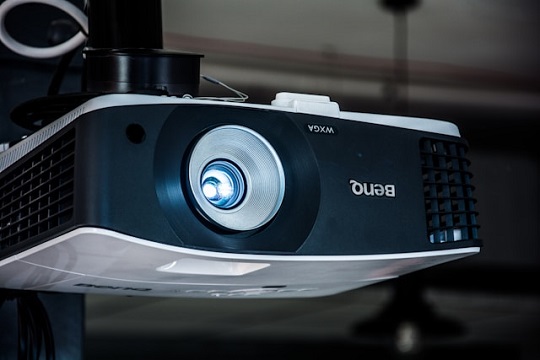
Scanners, projectors, and digital copiers: Serve as core materials for read/write and imaging lenses, enhancing device performance.
CD/DVD pickup heads: Ensure high-precision data reading.

Photolithography systems: High refractive index properties improve lithography resolution, meeting semiconductor manufacturing requirements.
AR/VR display modules: Lightweight design enhances user experience.
Drone camera lenses: Adapt to complex environments and deliver high-definition imaging.
Military optical instruments: Such as periscopes and lenses for infrared guidance systems, meeting rigorous performance standards.
The manufacturing process begins with careful control of raw materials. Consistent La₂O₃ quality is important for optical-glass producers. It helps reduce variations during batching. It also keeps the melting process more stable.
Manufacturers check La₂O₃ purity, trace impurities, particle size, moisture, and lot consistency before use.
La₂O₃ is combined with glass formers and modifiers. This mixture helps achieve the target refractive index and dispersion. It also optimizes viscosity, durability, and other essential properties.
The batch is melted under controlled conditions. Refining helps remove bubbles and promotes chemical uniformity.
Temperature and composition are carefully controlled to reduce striae and refractive-index variation.
The molten glass is formed into the required geometry and then annealed to reduce internal stress.
Finished glass is thoroughly evaluated before use. Key optical tests check the refractive index, Abbe number, and transmission. Material quality tests assess homogeneity and flag any physical defects. Lastly, dimensional checks ensure the glass meets exact design specifications.
Using lanthanum oxide in glass requires more than simply meeting a nominal purity number.
| Challenge | Possible effect | What to control |
| Moisture | Batch and melt variability | Storage and packaging |
| Trace impurities | Color or absorption | Impurity limits |
| Poor mixing | Striae or inclusions | Batch preparation |
| Inconsistent purity | Lot-to-lot variation | Incoming QC |
| Wrong optical constants | Design mismatch | Index and dispersion targets |
| Thermal mismatch | Stress or cracking | CTE and annealing |
| Supply inconsistency | Production delays | Supplier qualification |
Lanthanum oxide is a performance-critical raw material. It should not be treated as simply a commodity powder. Several key factors directly impact glassmaking results. These include purity, particle characteristics, and moisture control. Lot-to-lot consistency is also critical.
Buyers should prepare before requesting quotations. When sourcing lanthanum oxide for optical glass, it is important to define the requirements first.
Choose a supplier who can discuss material specs relative to your application. Application demands vary widely across industries. An optical-glass maker often requires strict impurity and particle-size controls. In contrast, other technical applications may have less demanding requirements.
AEM REE supplies high-purity rare-earth materials, including lanthanum oxide. We serve industrial, research, and technology-oriented customers. When evaluating a supplier for optical glass, buyers can discuss specific needs. Key topics include material purity, particle size, order quantity, and required documentation.
Lanthanum glass is a specialty material containing lanthanum. The element is usually introduced as lanthanum oxide (La₂O₃). It is widely used in optical and technical applications. In these uses, key properties must be carefully controlled. These traits include refractive index, dispersion, light transmission, and material consistency.
Lanthanum glass plays a major role in optical devices. It is key to precision lenses, cameras, microscopes, and telescopes. Scientific instruments and photonics systems also rely on it. Additionally, it serves in specialized shielding-glass applications. The suitable formulation depends on the required optical and physical properties.
Lanthanum oxide is a key additive in optical glass. It increases the refractive index. At the same time, it helps control optical dispersion. This gives designers added flexibility when developing compact lenses. It also assists in correcting chromatic aberration in precision imaging systems.
No. Lanthanum glass and ED glass are not automatically the same. Their performance depends on the complete glass composition and optical constants. Selecting the right glass requires reviewing several specifications. Designers should evaluate refractive index alongside the Abbe number. They must also assess partial dispersion, transmission levels, and additional performance requirements.
Ask your supplier about critical material specifications. Inquire about La₂O₃ purity, trace impurities, and particle size. Be sure to check moisture levels, LOI, lot consistency, and documentation like COAs and SDSs. Finally, confirm packaging, sample availability, lead time, and supply capacity. These details help manufacturers qualify a material before starting production.
Lanthanum glass is a family of specialty formulations. Each formula is designed for specific optical and technical requirements. Adding La₂O₃ can increase the refractive index. It also helps control optical dispersion. However, final performance depends on the complete formulation. The manufacturing process plays a critical role as well.
Choosing the right lanthanum oxide supplier is critical for manufacturers. It forms an important part of the material qualification process. AEM REE supports customers seeking high-purity lanthanum oxide. We also provide other rare-earth materials tailored to specific technical requirements.
Need lanthanum oxide for an optical-glass or specialty-glass project? Share your target purity, particle size, application, quantity, and documentation requirements with AEM REE to discuss a suitable material specification.
 +86-731-89578196