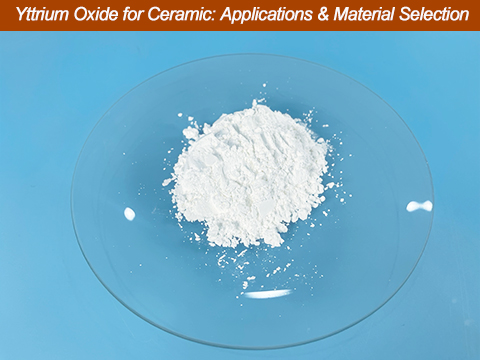
Yttrium oxide (Y₂O₃), also known as yttria, is an important raw material for advanced ceramic manufacturing. It is used to stabilize zirconia, produce high-performance ceramic components, develop thermal-barrier coatings, and support functional ceramic systems. However, the right yttrium oxide grade depends on the application, ceramic formulation, and processing conditions.
| Key factor | What ceramics buyers should know |
|
Chemical formula |
Y₂O₃ |
|
Common name |
Yttria |
|
Main role |
Ceramic raw material, functional additive, and zirconia stabilizer |
|
Major applications |
Zirconia ceramics, thermal-barrier coatings, dental ceramics, semiconductor ceramics, and fuel cells |
|
Important specifications |
Purity, impurity profile, particle size, surface area, phase, and batch consistency |
|
Main selection consideration |
Match powder characteristics and composition to the intended ceramic application and manufacturing process |
When sourcing yttrium oxide for ceramic production, buyers should look beyond the headline purity value. Chemical composition, particle characteristics, and batch consistency can also affect processing and final ceramic performance.
Yttrium oxide (Y₂O₃) is a rare-earth oxide used in advanced ceramic manufacturing. It can serve as a raw material, additive, or stabilizing component in ceramic materials. Its role depends on the final composition and the properties required.
In ceramic production, yttrium oxide is often used to help control phase stability, mechanical behavior, thermal performance, and electrical properties. It is especially important in zirconia-based ceramics, where adding yttria can stabilize certain crystal structures and change how the material behaves under different conditions.
There are three material types worth distinguishing:
These materials are related, but they are not interchangeable. When selecting yttrium oxide for ceramic production, buyers should confirm whether they need raw Y₂O₃ powder or an already prepared ceramic material.
Yttrium oxide is characterized by high hardness and high strength. The addition of an appropriate amount can significantly improve the hardness and strength of ceramic materials. This is because yttrium oxide can form robust chemical bonds within the ceramic matrix, thereby increasing the material's compressive strength and wear resistance.
Yttrium oxide can create conductive pathways within ceramic materials, thereby enhancing their electrical conductivity. This is of great significance for the preparation and processing of electronic ceramics.
Yttrium oxide can form a protective oxide film, which enhances the corrosion resistance of ceramic materials. Furthermore, it can adsorb certain harmful substances, thereby serving a purification function.
Yttrium oxide can absorb ultraviolet light and blue light, which reduces the transparency of ceramic materials. This is particularly useful for ceramic products that require controlled light transmission.
Yttrium oxide for ceramic production is relevant to several industries.

Yttria-stabilized zirconia (Y-TZP) ceramics exhibit a flexural strength of 900–1200 MPa and a fracture toughness of 8–10 MPa·m¹/². They combine high mechanical strength with excellent biocompatibility (e.g., posing no risk of metal allergies).
These ceramics are widely used in medical applications—such as dental prosthetics and orthopedic implants (e.g., femoral heads for hip replacements)—as well as in industrial sectors for components like cutting tools and bearing balls. When used for dental prosthetics, Y-TZP ceramics not only possess a hardness comparable to that of natural teeth but can also be tinted to achieve an aesthetically pleasing appearance.
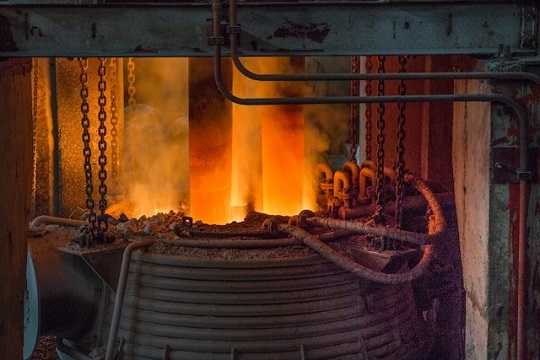
Yttria is utilized in components such as nozzles for aerospace engines and linings for high-temperature industrial kilns.
Incorporating yttria into alumina (Al₂O₃) ceramics facilitates the formation of a YAG (yttrium aluminum garnet) phase, which inhibits grain growth and enhances thermal shock resistance—making the material suitable for environments subject to extreme temperature fluctuations.
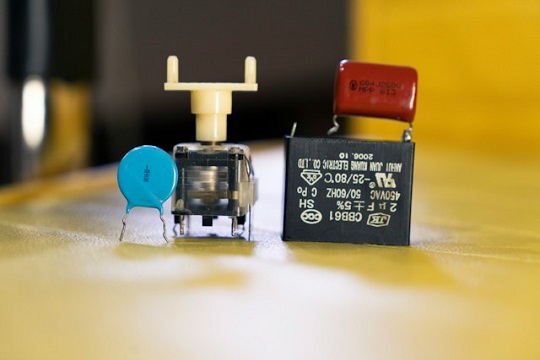
Doping with yttria allows for the adjustment of the dielectric constant in barium titanate (BaTiO₃)-based ceramics, ensuring stability at high frequencies. This makes them ideal for capacitive components in 5G telecommunications equipment.
Such materials are frequently employed in multilayer ceramic capacitors (MLCCs) and piezoelectric ceramic components.
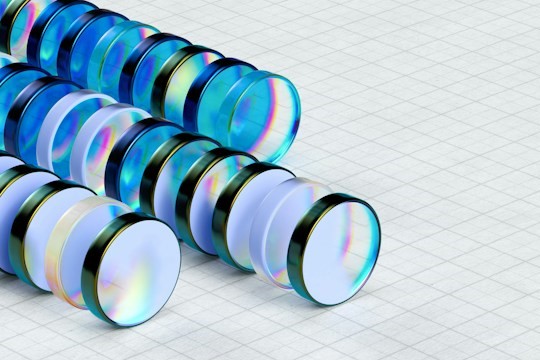
Yttria is also used in the production of laser window materials, infrared lenses, and high-temperature optical sensors.
Transparent yttria (Y₂O₃) ceramics, which feature a light transmission rate exceeding 85%, are used as windows for 1064 nm laser systems. They offer superior resistance to high temperatures and laser-induced damage compared to conventional glass.

Yttria is highly effective in thermal barrier coatings (TBCs), which are applied to components such as turbine blades in aerospace engines and parts for industrial gas turbines.
Yttria-stabilized zirconia (YSZ) coatings possess low thermal conductivity (approximately 2 W/m·K). By forming an insulating layer on the surface of a metal substrate, these coatings can reduce the substrate's temperature by 100–200°C, thereby extending the service life of the components.
Yttrium oxide is also frequently used in wear-resistant, anti-corrosion coatings.
Applying a Y₂O₃-Al₂O₃ composite ceramic coating to the surface of stainless steel can increase its surface hardness to over HV 1500, while providing better corrosion resistance than pure metal coatings.
Yttria content must be stated with a clear measurement basis. Mol% and wt% describe composition in different ways, so the same numerical value does not represent the same amount of yttrium oxide.
Ceramic specifications, research papers, and commercial material grades may use either unit. Buyers and engineers should always confirm which unit is being used before comparing formulations or preparing a material mixture.
For example, 8 mol% yttria and 8 wt% yttria are not equivalent zirconia compositions. Using the wrong basis can lead to formulation errors and unwanted changes in ceramic performance.
| Material or application | Yttria content | Unit | Context |
|
Commercial 3Y zirconia |
3 |
mol% |
Structural and wear-resistant ceramics |
|
Commercial 8Y zirconia |
8 |
mol% |
Functional zirconia applications |
|
Turbine thermal-barrier coating zirconia |
Approx. 7 |
wt% |
High-temperature coating systems |
These examples come from different material systems and application requirements. They should not be treated as a direct comparison of quality or performance.
When purchasing yttrium oxide for ceramic manufacturing, confirm the required composition, unit, and formulation basis with the technical team before placing an order.
The required purity of yttrium oxide depends on the ceramic application, manufacturing process, and sensitivity to impurities. High-purity material may be important for advanced ceramics, but the highest purity grade is not always necessary for every production process.
TREO refers to total rare-earth oxide content, while Y₂O₃/TREO describes the proportion of yttrium oxide within that total rare-earth oxide content.
These values are different and should not be confused with each other or automatically treated as the total purity of the powder.
For example, a specification of 99.999% Y₂O₃/TREO does not necessarily mean the entire powder has 99.999% total purity. Buyers should review the purity basis and supporting analytical data.
Impurities can influence ceramic processing and final properties, depending on the material system. They may affect sintering behavior, grain growth, phase composition, electrical performance, optical properties, or color.
For applications with strict material requirements, buyers should identify which impurities matter most and request relevant analytical results. A single headline purity value may not provide enough information to evaluate the powder.
When choosing yttrium oxide for ceramic applications:
This approach helps buyers select a suitable grade without paying for purity that may not provide meaningful value to the final ceramic product.
Purity is only one part of powder selection. Particle characteristics and material consistency can also influence ceramic processing, sintering, and final properties. When evaluating yttrium oxide for ceramic production, buyers should review several specifications together.
Particle size affects powder mixing, dispersion, packing, forming, and sintering. Particle-size distribution is also important. This is because a powder with a wide size range may behave differently from one with a more controlled distribution.
Buyers should confirm the required particle size, D50 where applicable, distribution range, and measurement method. Smaller particles are not always better. The right size depends on the formulation and process.
Specific surface area describes the surface area available per unit mass of powder. It can influence powder activity, mixing, and sintering behavior.
Agglomeration is another important factor. Powder particles may form clusters that affect dispersion and uniformity. If agglomerates are not properly controlled, they may influence forming or contribute to variations in the finished ceramic.
Phase composition and particle characteristics may be checked through methods such as X-ray diffraction (XRD) and other material-analysis techniques.
Depending on the application, buyers may also need information about particle morphology, surface area, moisture, or other powder characteristics. The test method should be clear so that results from different batches or suppliers can be compared.
| Specification | What buyers should confirm |
|
Chemical formula |
Y₂O₃ |
|
Purity |
Total purity and calculation basis |
|
TREO |
Total rare-earth oxide content |
|
Y₂O₃/TREO |
Yttrium oxide proportion within TREO |
|
Impurities |
Individual values or limits for critical elements |
|
Particle size |
D50, distribution range, and test method |
|
Specific surface area |
Value and measurement method |
|
Phase |
Required phase and analytical verification |
|
Batch consistency |
Batch-specific COA and repeatability |
|
Packaging |
Moisture protection and suitable storage packaging |
For example, commercial zirconia powders with the same nominal 8 mol% yttria content may have different specific surface areas. This shows why composition alone is not enough to describe powder characteristics.
A complete specification helps buyers evaluate whether a powder is suitable for their process, rather than relying on a single purity number.
Similar yttrium oxide purity grades do not guarantee identical ceramic results. Powder characteristics, formulation, processing, and testing conditions can all affect the final material.
If ceramic performance changes between trials or batches, check:
A systematic review of powder specifications, formulation, processing, and testing can help identify the source of inconsistent ceramic results more effectively than changing the yttrium oxide grade without investigation.
A clear request for quotation (RFQ) helps suppliers understand your application and recommend suitable material specifications. When sourcing yttrium oxide for ceramic production, prepare the following information:
The more clearly these requirements are defined, the easier it is for a supplier to evaluate your request and provide a relevant quotation.
If you are sourcing yttrium oxide for ceramic applications, AEM REE can discuss your purity, powder specifications, and quantity requirements. Send us your application and technical details to request a quotation and review the available material documentation.
Yes. Yttrium oxide (Y₂O₃) is commonly called yttria. Both names refer to the same chemical compound, which is used in ceramic materials, coatings, optical materials, and other advanced-material applications.
No. Yttrium oxide is a chemical compound, while yttria-stabilized zirconia is a zirconia-based ceramic containing yttria as a stabilizing component. Their compositions, properties, and uses are different.
Mol% is based on the relative number of moles, while wt% is based on mass. They use different calculation bases, so 8 mol% yttria and 8 wt% yttria represent different zirconia compositions.
Not necessarily. Y₂O₃/TREO describes the yttrium oxide proportion within the total rare-earth oxide content. Buyers should also check TREO, individual impurities, and the supplier's reported purity basis.
Yttrium oxide plays an important role in advanced ceramic manufacturing, from zirconia stabilization and wear-resistant components to thermal-barrier coatings, semiconductor ceramics, and electrochemical materials. Selecting the right yttrium oxide for ceramic production requires more than checking purity. Composition, impurity profile, particle size, surface area, and batch consistency should all match the intended application.
AEM REE supplies yttrium oxide for industrial applications and materials research. Contact us with your application, purity requirements, powder specifications, and quantity to discuss material options and request a quotation.
 +86-731-89578196