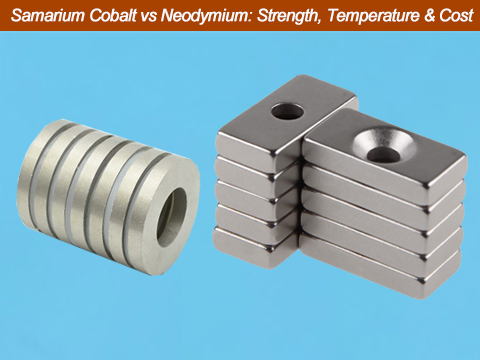
When comparing samarium cobalt vs neodymium, neither magnet is always the better choice. NdFeB usually provides higher magnetic strength and energy density. SmCo offers better high-temperature stability and corrosion resistance.
| Property | NdFeB | SmCo |
| Magnetic strength | Higher | Lower |
| Maximum energy product | About 30–55 MGOe | About 16–32 MGOe |
| Typical operating temperature | About 60–220°C by grade | About 250–350°C by grade |
| Temperature stability | Good to moderate | Excellent |
| Corrosion resistance | Lower; coating often needed | Generally better |
| Size efficiency | Excellent | Good |
| Relative cost | Usually lower | Usually higher |
| Best fit | Compact, high-output systems | High-temperature, harsh environments |
Choose NdFeB when high magnetic output, compact size, and cost efficiency are the main priorities.
Choose SmCo when high temperature, corrosion resistance, and long-term magnetic stability are more important.
Material selection depends on multiple design variables. Engineers must assess magnet grade alongside maximum operating temperature. The magnetic circuit layout and physical geometry are equally critical. Operating environment and target service life complete the evaluation.
NdFeB and SmCo are both high-performance rare-earth permanent magnets. However, their material composition gives them different performance characteristics.
A neodymium magnet, also called a neodymium-iron-boron (NdFeB) magnet, is mainly made from neodymium, iron, and boron. It has a very high magnetic energy density and is widely used when strong magnetic performance is needed in a small space.
Common applications include EV motors, robotics, sensors, speakers, actuators, electronics, and wind generators.
A samarium cobalt (SmCo) magnet is a rare-earth magnet made primarily from samarium and cobalt. Common material families include SmCo₅ and Sm₂Co₁₇.
SmCo generally produces less magnetic energy than NdFeB. However, it performs much better at high temperatures. It also has stronger inherent resistance to corrosion and oxidation. These properties make it ideal for aerospace systems and satellite equipment. It is also widely used in high-temperature sensors and actuators.
The most important difference in samarium cobalt vs neodymium is the balance between magnetic strength and environmental stability.
| Magnetic property | NdFeB | SmCo | What it means |
| Remanence (Br) | Generally higher | Generally lower | Indicates remaining magnetic flux after magnetization |
| Maximum energy product (BHmax) | About 30–55 MGOe | About 16–32 MGOe | Indicates magnetic energy density |
| Coercivity (Hcj) | High, depending on grade | High | Indicates resistance to irreversible demagnetization |
| Curie temperature | About 310–370°C | About 700–850°C | Indicates the temperature at which permanent magnetic order is lost |
Indicates the temperature at which permanent magnetic order is lost
Remanence (Br) is the magnetic flux density that remains after the magnetizing field is removed. Higher remanence can support stronger magnetic output.
Intrinsic coercivity (Hcj) describes how well a magnet resists demagnetization.
Maximum energy product (BHmax) measures the magnetic energy available per unit volume. A higher value can allow a smaller magnet to provide the required magnetic performance.
The actual values vary by grade and manufacturer. Therefore, buyers should compare grade-specific data rather than relying only on the material name.
NdFeB is currently the permanent magnet material with the highest magnetic energy product. Its maximum magnetic energy product can exceed 50 MGOe, with a remanence of up to 1.4 T and a coercivity exceeding 1000 kA/m. These exceptional magnetic properties give it a decisive advantage in miniaturized devices requiring high power density, such as drive motors for new energy vehicles and vibration motors for smartphones.
In contrast, Samarium-Cobalt (SmCo) typically has a magnetic energy product in the range of 25–35 MGOe. Although it falls short of NdFeB in this regard, SmCo offers significantly superior high-temperature stability.
SmCo magnets exhibit exceptional performance in high-temperature environments; second-generation Sm₂Co₁₇ magnets can operate at temperatures up to 350°C with a temperature coefficient of only -0.03%/°C (far lower than the -0.12%/°C of NdFeB magnets).
Test data from an aero-engine application shows that at 200°C, SmCo magnets experience a magnetic flux loss of only 5%, whereas N52-grade NdFeB magnets suffer a loss of up to 15% under the same conditions. This makes SmCo the preferred choice for high-temperature applications such as aerospace and oil drilling.
Typical temperature ranges can be summarized as follows:
| Magnet type or grade range | Approximate temperature capability |
| Standard NdFeB | 60–80°C |
| Medium-temperature NdFeB | 100–150°C |
| High-temperature NdFeB | 180–220°C |
| SmCo | 250–350°C |
Special NdFeB grades can therefore handle much higher temperatures than standard NdFeB. However, SmCo generally provides a wider temperature margin.
It is also important to distinguish Curie temperature from maximum operating temperature. A magnet does not need to reach its Curie temperature before its magnetic performance becomes unacceptable.
For this reason, SmCo is often preferred for sustained high-temperature applications. The exact limit still depends on the SmCo grade, magnet geometry, magnetic circuit, and operating conditions.
Sometimes. A high-temperature NdFeB grade can be a suitable alternative in certain conditions. The magnet temperature must stay within its validated operating range. The environment also requires proper control.
However, when temperatures approach or exceed NdFeB's practical limits, SmCo deserves serious consideration. Its superior temperature stability makes it the safer choice.
SmCo magnets possess inherent resistance to oxidation and corrosion, allowing them to operate reliably over long periods in humid or salt-spray environments without the need for surface treatment.
In contrast, NdFeB magnets are highly susceptible to oxidation and require protective measures—such as nickel plating or epoxy resin coating—to prevent failure due to pulverization in hot, humid conditions.
Comparative tests conducted for an offshore wind power project revealed that unprotected NdFeB magnets suffered a 20% loss in magnetic strength after six months in a marine atmosphere, whereas samarium-cobalt magnets experienced a loss of less than 3% over the same period.
| Environment | Material to evaluate first | Main consideration |
| Dry indoor environment | NdFeB | Magnetic output and cost |
| Humid environment | Coated NdFeB or SmCo | Moisture and coating performance |
| Salt spray | SmCo or protected NdFeB | Corrosion resistance |
| Chemical exposure | SmCo or application-specific material | Chemical compatibility |
| High-temperature equipment | SmCo or high-temperature NdFeB | Actual magnet temperature |
| Harsh environment | SmCo | Stability and lifecycle requirements |
SmCo is not immune to environmental damage, so the complete application should still be tested and qualified.
In many moderate-temperature applications, NdFeB offers an attractive balance of magnetic performance and material cost. Its higher energy density can also reduce the amount of magnet material required.
SmCo generally has a higher upfront cost. However, comparing only the magnet price can lead to the wrong decision.
A more useful approach is to consider total cost of ownership:
Total Cost of Ownership = Magnet Cost + Coating + Assembly + Qualification + Maintenance + Failure Risk
For example, coated NdFeB may be an excellent choice for a sealed industrial motor operating at moderate temperatures. In contrast, SmCo may provide better overall value for an inaccessible actuator exposed to high heat. In this application, magnet failure could result in expensive maintenance or system downtime.
For procurement, the RFQ must clearly state key material specs. Include the required magnet grade, magnetic properties, and temperature limits. Specify exact dimensions and coating needs. Finally, list total quantity, testing criteria, and documentation requirements.
The best material depends on the actual operating conditions. The following table provides a starting point for evaluating samarium cobalt vs neodymium by application.
| Application | Starting material to evaluate | Main reason |
| EV traction motors | NdFeB | High energy density |
| Robotics | NdFeB | Strong output in a compact size |
| Servo motors | NdFeB | High performance and size efficiency |
| Speakers | NdFeB | High strength-to-volume ratio |
| Wind generators | NdFeB | High magnetic energy density |
| Aerospace actuators | SmCo | High-temperature stability |
| Satellite systems | SmCo | Temperature and environmental stability |
| High-temperature sensors | SmCo | Better retained magnetic performance |
| Harsh industrial equipment | SmCo or high-temperature NdFeB | Depends on temperature and environment |

The micro NdFeB magnets used in Apple's Taptic Engine are only 0.3mm thick. It delivers precise haptic feedback thanks to their high magnetic energy product.
The rear-drive motor of the Tesla Model 3 utilizes sintered NdFeB magnets. 2.4kg magnets are used per motor, which achieves an energy conversion efficiency exceeding 97%.
ABB's high-efficiency permanent magnet synchronous motors meet IE5 energy efficiency standards through the use of NdFeB magnets. This offers 30% greater energy savings compared to conventional motors.

SmCo magnets are used in the attitude control thrusters of SpaceX rockets. This helps maintain stability across extreme temperature cycles ranging from -270°C to 300°C.
Shimming magnets in MRI scanners must operate continuously in a liquid helium environment (4.2K). SmCo's low-temperature stability far surpasses that of other materials.
Material selection for high-stakes industries demands thorough validation. Defense, aerospace, and medical tech require dedicated testing. Qualify materials based on actual application performance rather than general industry labels.
Evaluating samarium cobalt vs neodymium requires the right priorities. Focus on application demands first. Material costs should only be evaluated after performance needs are defined.
Several common mistakes can lead to poor magnet selection.
| Common mistake | Better approach |
| Selecting only by room-temperature strength | Compare magnetic performance at the actual operating temperature |
| Assuming all NdFeB grades perform the same | Specify the complete grade and required properties |
| Using ambient temperature as magnet temperature | Measure or model the actual magnet temperature |
| Ignoring corrosion exposure | Evaluate base material, coating, and complete assembly |
| Assuming SmCo is mechanically tough | Account for its brittle nature during design and assembly |
| Comparing only unit price | Compare total lifecycle cost |
| Omitting traceability requirements | Define COA, inspection data, and lot control |
Both SmCo and NdFeB are brittle materials. Mechanical design, machining, handling, and assembly therefore require care.
No. NdFeB generally has a higher maximum energy product. It can provide more magnetic output from a smaller volume. SmCo is selected for its high-temperature stability and corrosion resistance. It also delivers reliable performance in demanding environments. Engineers do not choose it primarily for maximum room-temperature magnetic strength.
SmCo is generally better for sustained high-temperature applications. Specialty NdFeB grades can reach approximately 220°C. Suitable SmCo grades commonly operate around 250–350°C. The actual limit depends on grade, geometry, magnetic circuit, and operating conditions.
Yes. NdFeB can corrode, particularly in humid or aggressive environments. Protective coatings are commonly used to improve environmental resistance. However, you must evaluate the coating type and surface quality carefully. Operating temperature, chemical exposure, and assembly conditions also require thorough testing.
SmCo generally costs more because of its material composition and processing requirements. However, the higher upfront investment is often justified. High-temperature stability and corrosion resistance provide long-term value. Preventing system failure frequently outweighs initial magnet costs.
Sometimes. High-temperature NdFeB is a viable option under specific conditions. The magnet must stay within its validated temperature range. Environmental factors also need active management. SmCo becomes the better choice when sustained high temperatures are present. It's also preferred when corrosion resistance or long-term magnetic stability are critical.
The right choice in samarium cobalt vs neodymium depends on what the magnet must do in service.
NdFeB is usually the better choice for high-power demands. It prioritizes maximum magnetic energy density, compact size, and cost efficiency. SmCo is often the better option for harsh conditions. It excels when high temperatures, corrosion resistance, and stable magnetic performance matter most.
AEM REE supplies both NdFeB and SmCo magnet materials. Our lineup includes rare-earth metals, oxides, alloys, compounds, fabricated forms and sputtering targets. For material recommendations or RFQs, submit your core design specs. Include required magnetic properties, physical dimensions, operating temperatures, and environmental conditions. Stating quantity and documentation needs ensures an accurate match for your production runs.
 +86-731-89578196