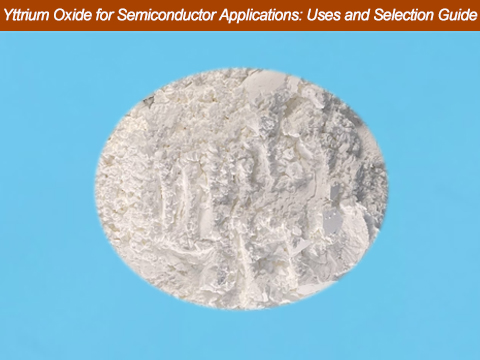
Yttrium oxide (Y₂O₃), also called yttria, is widely used in semiconductor manufacturing. It primarily serves as a plasma-resistant coating and ceramic component in processing equipment. Researchers also study it as a high-k dielectric thin-film material. Selecting the right yttrium oxide grade depends on several key factors. These include purity, impurity profile, particle characteristics, processing route, and required performance.
| Application | Role of Y₂O₃ | Key Buyer Considerations |
| Plasma-resistant coatings | Protects chamber-facing components from reactive plasma | Purity, impurities, particle size, phase, morphology |
| Ceramic components | Feedstock for yttria-based ceramic parts | Powder characteristics, sintering behavior, density |
| Thin-film research | High-k insulating or dielectric layer | Deposition method, precursor compatibility, film properties |
| R&D | Material for coating and process development | Consistency, traceability, analytical data |
For engineers and procurement teams, buying yttrium oxide is not simply about choosing the highest purity number. The material must match the intended semiconductor process. Buyers should also verify key material traits before qualification. Important factors include specific impurities, particle size, phase, testing methods, and lot consistency.
Yttrium oxide is a type of rare-earth oxide material. A key reason it has attracted attention in the field of semiconductor plasma equipment is its excellent chemical stability and corrosion resistance in fluorine-containing plasma environments.
Studies have shown that Y₂O₃ coatings prepared via atmospheric plasma spraying (APS) are used to mitigate damage to internal chamber components caused by highly corrosive fluorine-containing plasma during dry etching processes.
In other words: it effectively adds a "plasma-corrosion-resistant protective layer" to the interior of the equipment.
The substrate provides the component's structural functionality, while the surface Y₂O₃ coating bears the brunt of the etching environment.
In semiconductor-related applications, yttrium oxide has two distinct roles:
These applications should not be treated as interchangeable. Plasma-resistant coating powders have specific qualification needs. Research precursors and thin films follow different standards. Each material form must be evaluated for its specific electronic or processing role.
Most importantly, yttrium oxide is not the semiconductor substrate itself. Its function depends on where it is introduced into the manufacturing or research process.
Semiconductor plasma processes expose chamber-facing materials to reactive gases, ions, and energetic particles. Over time, this environment damages exposed surfaces. Degradation occurs through both chemical reactions and physical bombardment.
Yttrium oxide is widely used and studied as a protective ceramic coating. Its surface withstands demanding plasma environments exceptionally well. Under appropriate conditions, it outperforms many conventional materials.
Surface erosion is more than a coating-life issue. When a chamber material degrades, particles or reaction products may be generated. These particles can become a contamination concern for wafers and other sensitive components.
However, "plasma resistant" does not mean "erosion-proof". Yttria performance depends on factors such as:
Research on fluorine-based plasma offers a clear example. Studies show that increasing bias voltage leads to greater physical damage. Higher voltage directly accelerates surface wear on yttria components. This demonstrates why a powder's chemical specification alone cannot predict final coating performance.
A useful way to evaluate the material is:
Y₂O₃ powder → coating process → coating microstructure → plasma exposure → erosion → particle generation
For coating manufacturers, consistent feedstock is critical. However, high-quality raw materials alone are not enough. The finished coating must still be qualified under actual intended plasma conditions.
Yttrium oxide can enter the semiconductor supply chain in several forms and at different stages.
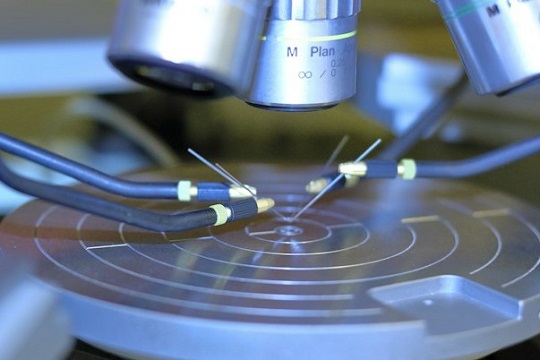
Powder can serve as feedstock for yttria-based coatings applied to semiconductor processing equipment. This makes high-purity Y₂O₃ relevant to coating manufacturers and equipment-component suppliers.
The required powder characteristics depend on the coating process. Therefore, buyers should define the process before selecting a grade.
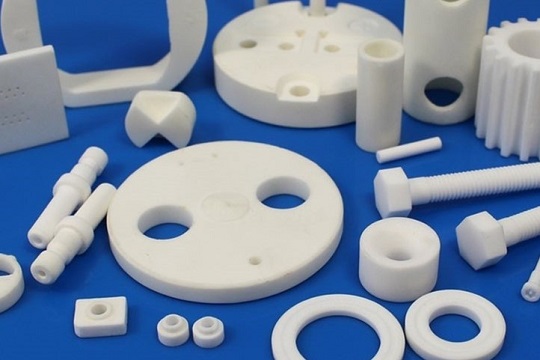
Yttrium oxide also serves as a ceramic feedstock. It's widely used to produce components for demanding environments. In these applications, powder characteristics play a vital role. They directly affect forming, sintering, final density, and overall ceramic properties.
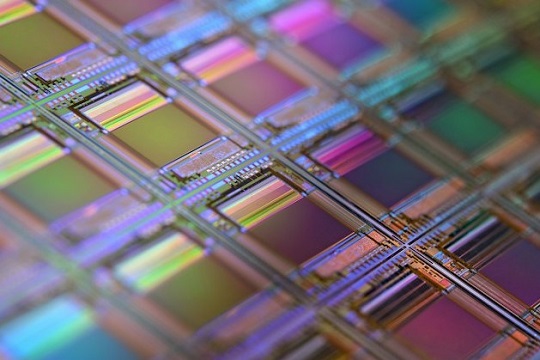
Yttrium-containing materials are also studied for thin-film deposition. However, material forms are not interchangeable. Standard yttrium oxide powder cannot replace specialized precursors. Processes like atomic layer deposition (ALD) require distinct, engineered chemical inputs.
This distinction is important when evaluating yttrium oxide for semiconductor applications.
The most important yttrium oxide specifications are not limited to overall purity. Buyers should evaluate the complete material specification against the intended processing route.
| Specification | Why It Matters | What to Ask the Supplier |
| Purity | Indicates overall chemical quality | How is purity defined? |
| Individual impurities | Trace elements may affect processing or performance | Which impurities are controlled and reported? |
| Particle size | Can affect feeding, coating, and sintering | Are D10, D50, and D90 available? |
| Morphology | Influences powder flow and processing behavior | Is morphology characterized? |
| Phase composition | Can affect material behavior | Is XRD data available? |
| Moisture/LOI | Can affect process consistency | What limits and test methods apply? |
| Traceability | Supports qualification and repeat orders | Can each lot be linked to test data? |
| Packaging | Helps protect material quality | What packaging is used? |
Purity should always be considered together with the impurity profile. Two products with similar headline purity values may have different levels of specific elements.
Particle size is also important. Depending on the process, buyers may need D10, D50, and D90 values rather than a simple average particle size. Morphology and agglomeration can also affect powder behavior.
For chemical composition, techniques such as ICP-MS and XRF can provide useful information. XRD can help assess phase composition, while TGA can be used to evaluate moisture and volatile content. Buyers should confirm which tests are performed on each quoted lot and what detection limits apply.
No. A 99.999% yttrium oxide specification does not, by itself, prove semiconductor suitability. Application qualification depends on several key technical factors. Material purity and specific particle characteristics must be verified. Processing compatibility and full analytical data are also essential. Finally, the material must demonstrate proven performance in its finished form.
This is especially important when comparing yttrium oxide products.
TREO means Total Rare Earth Oxides. A specification such as Y₂O₃/TREO describes the amount of yttrium oxide relative to the total rare-earth oxide fraction.
For example, a published yttrium oxide information lists could be:
These numbers should not automatically be interpreted as 99.999 wt% Y₂O₃ in the entire powder.
Therefore, buyers should request a complete composition report. Suppliers must provide individual impurity results alongside method detection limits. It is also essential to verify the calculation basis used for reported purity values.
Key point: Understand what the percentage measures before comparing two yttrium oxide grades.
Powder characteristics can influence what happens after the material enters a coating or ceramic process.
Particle-size distribution, agglomeration, morphology, and consistency can affect how the powder is processed. After processing, coating microstructure, defects, and crystallographic characteristics can influence plasma behavior.
Smaller particles are not automatically better. The appropriate particle size depends on the specific coating, sintering, or forming method.
The relationship can be summarized as:
Powder characteristics → Processing conditions → Final microstructure → Application performance
This is why buyers should avoid selecting yttrium oxide based only on purity or particle size. A material that works well in one process may require a different specification in another.
For repeated production, lot-to-lot consistency is also important. A stable specification helps manufacturers reduce process variation and makes material qualification easier.
There is no universal winner between Y₂O₃, YF₃, and YOF. Selection depends heavily on your operating environment. Environmental drivers include plasma chemistry and ion energy levels. Material drivers include coating structure, preparation methods, and target performance metrics.
Y₂O₃ is an important yttrium-based ceramic coating material. YF₃ and yttrium oxyfluoride systems are also investigated as alternatives for plasma-facing applications.
A study comparing Y₂O₃ and YF₃ coatings in an NF₃/Ar/O₂ plasma environment showed that coatings located in the electrode area and on the chamber walls did not behave exactly the same. Material loss occurs at locations subject to strong ion bombardment, and reaction by-products may be redeposited in some wall areas.
In particular, the study noted that the specific location of the material within the cavity significantly affects erosion and particle generation behavior.
Therefore, plasma resistance is actually the result of: "material composition + microstructure + surface state + plasma conditions + component location".
This does not mean YF₃ is always better than Y₂O₃. Instead, it shows why coating materials should be compared under defined and relevant test conditions.
For procurement teams, the right question is not simply "Which material is best?" It is "Which material meets our plasma, coating, and contamination requirements?"
Yes. Y₂O₃ has been studied as a high-k dielectric. This is because it is an insulating material with relatively high dielectric permittivity. However, research findings on thin films do not automatically apply to bulk materials. Buyers must avoid using thin-film data as universal powder specs. Commercial yttrium oxide powder must be evaluated against its own specific requirements.
Yttrium oxide thin films have been investigated for electronic structures. In these area, electrical insulation and dielectric behavior are important.
One ALD study reported the following properties for its Y₂O₃ films:
| Property | Reported Result |
| Optical band gap | 5.56 eV |
| Dielectric permittivity | 11 |
| Leakage current density | Approximately 10⁻⁷ A/cm² at 2 MV/cm |
| Breakdown field | 4.0–7.5 MV/cm |
These are study-specific thin-film results, not guaranteed properties of every yttrium oxide powder or coating.
Powder purity and thin-film performance are different qualification categories. Thin-film properties depend heavily on the deposition process and substrate choice. Film thickness, interface quality, defect density, and post-deposition treatments also play critical roles.
Therefore, buyers must clearly define their material requirements when sourcing yttrium oxide. Specify whether you need raw powder or ceramic feedstock. Clearly indicate if the order is for a protective coating material or a specialized deposition precursor.
A practical qualification process can reduce material and process risks.
Clearly state the intended process for the material. Specify if it will be used for plasma coating or ceramic production. Note whether it is meant for sintering, thin-film research, or another specific application.
Define clear technical requirements for your material. Specify overall purity levels along with limits for individual impurities. Set parameters for particle size, morphology, phase, and moisture content where relevant.
Request a certificate of analysis, test methods, lot information, and relevant detection limits.
A supplier's material specification does not replace application testing. Evaluate the material using the actual coating, ceramic, or deposition process where possible.
Depending on the application, assess coating performance, particle generation, ceramic properties, or thin-film electrical performance.
For production sourcing, discuss lot consistency, packaging, traceability, documentation, and change notification.
The key distinction is between material qualification and finished-part qualification. A high-quality starting material does not guarantee a specific coating or component performance.
A useful RFQ should give the supplier enough information to match the material to the application.
Need yttrium oxide for a coating, ceramic, or research application? To find the right material, provide key specifications to AEM REE. Outline your intended application and target purity basis. Clearly state your required quantity, particle-size distribution, and documentation needs for proper evaluation.
Yttrium oxide is mainly used for plasma-resistant coatings and ceramic components in semiconductor processing equipment. It is also studied as a high-k dielectric thin-film material.
Yttrium oxide is an electrically insulating ceramic material. In electronic research, it can function as a dielectric layer rather than as the semiconductor itself.
Yttria can provide resistance to demanding plasma environments and help protect chamber-facing surfaces. Its actual performance depends on plasma conditions and coating microstructure.
No. Buyers should also evaluate individual impurities, particle characteristics, analytical methods, processing compatibility, and application-specific performance.
Y₂O₃/TREO indicates the yttrium oxide content relative to the total rare-earth oxide fraction. It should not automatically be read as the Y₂O₃ percentage of the entire powder.
Not universally. Published comparisons can show different results under specific plasma conditions. Materials should be evaluated using the conditions relevant to the intended process.
Not necessarily. ALD may require a specialized chemical precursor. Y₂O₃ powder and an ALD precursor should be treated as different material categories.
Include the application, processing route, purity basis, impurity limits, particle size, phase or morphology requirements, quantity, testing, documentation, and packaging needs.
Yttrium oxide (Y₂O₃) plays an important role in semiconductor-related materials. It is widely used in plasma-resistant coatings, ceramic components, and dielectric thin-film research. However, selecting the right material requires more than looking at a high purity number. Purity basis and individual impurity levels directly impact performance. Particle size, morphology, phase composition, moisture content, traceability, and processing requirements must also be evaluated.
Coating manufacturers, ceramic processors, equipment suppliers, and research teams should adopt a clear qualification strategy. First, define the specific application. Next, qualify the yttrium oxide under actual process conditions. A material meeting chemical specs may still require hands-on application testing before production approval.
AEM REE supplies yttrium oxide for industrial and research applications. We offer specification-based sourcing and flexible customization options. If you need yttrium oxide for semiconductor coatings, ceramic processing, or materials research, share your details with our team. Please provide your required purity, impurity limits, particle size, quantity, application, and documentation needs. Contact AEM REE today to discuss your project and request a tailored quotation.
 +86-731-89578196